


 Cyber Awareness Training



5-MIN READ
Is It Time to Start Outsourcing Cyber Security for Your Business?
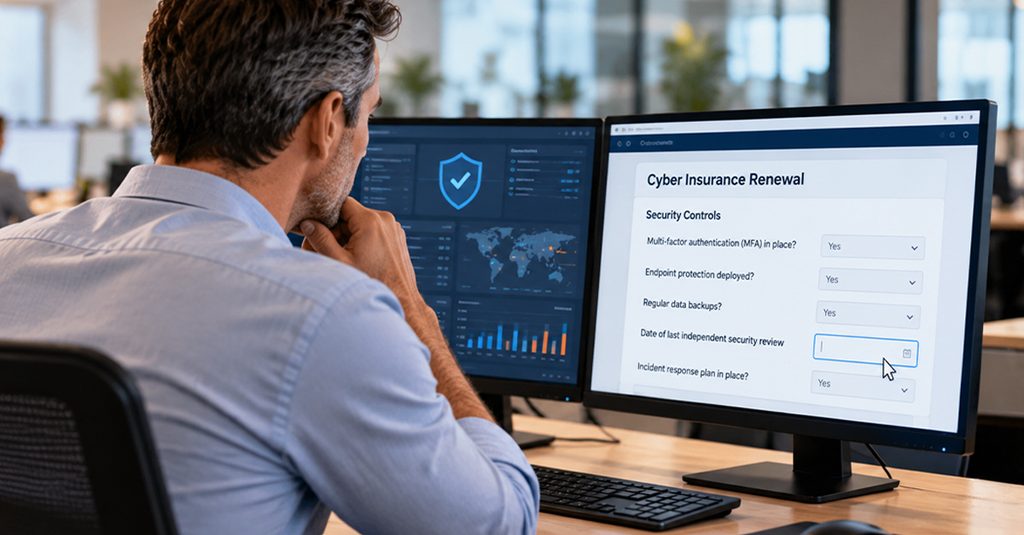
Your cyber insurance renewal is open on your second screen. You tick yes for multi-factor authentication, because your IT provider switched it on last year. The next field asks for the date of your last independent security review. The box sits empty.
That empty field isn't your IT provider dropping the ball. An independent review was never in their agreement, so the job sat with you.
In my experience, outsourcing cyber security means adding specialist skills while your current IT support stays put. Whether you need that depends on your risks and your current team's capacity.
Until this form asked, there was no reason for it to come up.
Quick Summary
Outsourcing cyber security means bringing in a specialist to sit beside the IT provider you already have. It makes sense once your business has outgrown its security setup, or when an insurer or client asks for proof you can’t put your hands on. A gap analysis ranks what to fix first.
What's Below
WHAT ARE SPECIALIST CYBER SECURITY SERVICES AND WHAT WOULD I GET?
Specialist cyber security services are the people you bring in to find where your business is exposed and help you close it, once or on an ongoing basis.
Your IT support keeps your systems running. A specialist looks at them the way an attacker would, starting with the old laptop that missed its last few updates.
The first piece of work is a cyber security maturity assessment, which shows where you sit against a recognised framework. The gap analysis after it tells you what to fix first. Governance is the paperwork your insurer keeps asking about, from security policies to an incident response plan your team can pick up on a bad Monday. Compliance alignment checks all of it against the Privacy Act, or that clause buried in a client contract.
Then there’s the hands-on work. Managed security services put a team on your alerts at 3am so you’re not the one watching. Penetration testing is a controlled attack you pay for, so the weak spots turn up on paper first.
DO I NEED A CYBER SECURITY SPECIALIST IF I ALREADY HAVE AN IT PROVIDER?
You might not need a separate specialist if your IT provider already covers the testing and reporting your risks call for.
Some managed IT providers run their own security teams. The gap shows when your provider's working hours all go to helpdesk tickets, or a client wants testing that your agreement leaves out.
Specialist support isn't automatically independent. If your IT provider also assesses your security, ask how they keep those roles apart. If you'd like a governance-led view, ADITS' partner Advanta Advisory offers cyber security consulting.
WHY AREN'T MY SECURITY TOOLS ENOUGH ON THEIR OWN?
Security tools only protect you once they're set up for your business and watched by a person who acts on alerts.
That multi-factor authentication tick is real. On Microsoft 365 Business Premium, you're also paying for Microsoft Defender for Business, which watches your devices for threats, and Microsoft Entra ID P1, Microsoft's identity and access management tool. Both need configuring for your business before they earn their keep.
The question is who configures them. If your IT agreement includes security configuration reviews, it's your provider. If it doesn't, it's the specialist you bring in, and until then it's you.
Once you can see what each service does, you can match it to the gap on your form. When that gap is worth closing comes next.
WHEN WOULD SPECIALIST CYBER SECURITY SERVICES ADD THE MOST VALUE FOR ME?
Specialist cyber security services pay off most when your security is still set up for the business you were three years ago.
A second site adds a network your IT provider secures from a distance. Switch on Microsoft Copilot, the AI assistant in Microsoft 365, and it’ll happily find the payroll spreadsheet for a staff member who had access to that folder all along and never knew it.
Every change like that deserves a second look from a specialist, and these next three things show where that look matters most.
HOW CAN SPECIALIST SUPPORT HELP ME MEET COMPLIANCE REQUIREMENTS?
Specialist support helps you meet compliance requirements by giving you something to hand over when an auditor or insurer asks, like documented controls and a dated review.
The Privacy Act is law. Under Australian Privacy Principle 11, a covered business must take reasonable steps to protect personal information, including technical and organisational measures. Businesses turning over $3 million or less are generally exempt, for now.
Insurance conditions and client questionnaires are contractual obligations. A specialist assesses your controls against whichever applies and prepares the evidence with you. That doesn't guarantee compliance, and a provider who promises it is overselling.
HOW DO I KNOW HOW MATURE MY CYBER SECURITY IS AND WHERE THE GAPS ARE?
A cyber security maturity assessment measures you against a recognised framework, and a cyber security gap analysis ranks what's missing by risk.
The assessment scores you against a framework such as SMB1001, a standard for small and medium businesses, or the Essential Eight, the Australian Signals Directorate’s baseline strategies. Your maturity is the level you reach, and the gaps are the controls between you and the next one.
My test for a good gap analysis is whether you could explain the top three findings to your business partner. Without an IT person in the room.
WHAT DOES A MORE STRATEGIC APPROACH TO SECURITY LOOK LIKE?
A more strategic approach to security puts your fixes on a prioritised list with its own budget line and a standing spot in your leadership meetings.
The people approving that budget line usually weren’t in the room for the gap analysis. Cyber security training for executives gives them enough grounding to weigh a risk, and to know who picks up the phone when an incident hits. It changes the questions they ask at the next board meeting.
AHEAD OF THE AUDITORS
When the 2014 Privacy Act amendments took effect, Centacare North Queensland wanted to understand its new obligations. ADITS helped Centacare plan for a possible data breach and strengthen its security governance. Centacare's audits found it compliant with the requirements, and its cyber security processes passed every test.
None of this replaces your IT provider. It hands them a list of priorities to work from.
HOW DOES OUTSOURCING CYBER SECURITY WORK ALONGSIDE MY EXISTING IT?
Outsourcing cyber security sits alongside your IT. Your provider still answers the helpdesk calls and patches the laptops. The specialist comes in to test what’s been set up and tells you, in writing, what needs fixing.
Where I’ve seen this go wrong is the bit in between. The report goes to you, you forward it to your IT provider, and by the next renewal half of it is still open. Before the report lands, agree who’s chasing each fix and put a name next to it.
WHO WOULD BE RESPONSIBLE FOR WHAT IN MY BUSINESS?
In a shared security setup, the calls on risk and spend stay with you. Your IT provider does the hands-on work, while the specialist checks it and keeps watch.
| Who | What they own |
| You and your leadership team | Signing off what gets fixed and what it costs |
| Your IT provider | Running your systems and making the fixes on the list |
| Your specialist provider | Assessment, advice, testing or monitoring |
| Shared | Tracking fixes to completion and coordinating during an incident |
Your agreements decide the final split. If a task isn't written into either one, treat it as yours until it is.
WHAT ARE MY OPTIONS FOR BRINGING IN SPECIALIST SUPPORT?
Specialist support doesn’t have to mean a long contract. It can be one job before your renewal, or it can stay on.
A one-off assessment is the quick version. You get the dated review your insurer wants, plus a list of gaps. Fixing those is a separate project, done once, and then your IT provider takes it from there. If client questionnaires keep landing on your desk, ongoing advisory means you’ve got a specialist to ring about them. Co-managed security works with your internal IT person, and fully managed security operations watch your systems day and night.
My advice is to start with the smallest model that fills your gap. Who delivers it matters just as much.
WHAT SHOULD I LOOK FOR IN A CYBER SECURITY PROVIDER?
A good cyber security provider can tell you which framework fits a business your size, and what you'll hold at the end.
I judge providers on whether they respect the IT relationship you already have, and whether their reports make sense to the person paying. Take these questions into your first meeting.
FOUR QUESTIONS TO ASK
- Which framework suits a business our size, and why?
- How will you work with our IT provider?
- Do we get a report, a roadmap or ongoing reporting?
- How will you explain our risks to leadership without jargon?
The answers show whether a provider can put a date in that box you’d stand behind.
WHAT WOULD SPECIALIST SUPPORT FROM ADITS LOOK LIKE FOR ME?
Specialist support from ADITS starts with CyberShield, a cyber security service designed around SMB1001.
CyberShield puts 24/7 threat monitoring alongside the written policies and plans your insurer asks to see, and your team gets cyber awareness training. If you'd rather have IT and security under one roof, it sits within ADITS' managed IT services.
You keep the say on every priority and every dollar.
SUMMARY
Outsourcing cyber security doesn’t touch the IT provider who switched on your multi-factor authentication. It picks up the one job their agreement never mentioned, and leaves you with a gap analysis that says what to fix first and whose desk each fix lands on.
At your next renewal, you type a date into that field, with a report and a plan behind it. You hit submit, and you relax.
Explore specialist support for your business with ADITS' cyber security services.
FREQUENTLY ASKED QUESTIONS
HOW MUCH WOULD SPECIALIST CYBER SECURITY SERVICES COST ME?
A single assessment for a 20-person office is a smaller job than continuous monitoring across three sites. Ask each provider to scope your systems before quoting, and check whether fixing what the assessment finds is included or priced after the report. For ongoing support, ask whether the monthly fee is per user, per device or flat.
HOW OFTEN SHOULD I REVIEW MY CYBER SECURITY MATURITY?
Line the review up with your insurance renewal, and the date in that field stays under a year old. A new site, a new core system or a Copilot rollout all count as significant changes. Between reviews, your roadmap gives your IT provider a list to work through, so each review picks up where the last one finished.
IS MY BUSINESS TOO SMALL FOR SPECIALIST CYBER SECURITY SERVICES?
SMB1001’s tiered levels let a five-person practice start with the controls that matter most and build from there. A practice that size still holds client records and still gets the insurance questionnaire. It just has fewer people to work out the answers.
Most Popular
-

How to Choose a Managed IT Security Provider in Cairns
-

Cyber Security Services That Protect Your Nonprofit’s Data like a Reef
-

Professional Cyber Security Services for Brisbane & Townsville Businesses
-

What Are Cyber Security Tools? 10 Essential Types Every Company Should Know
-
Why Is Cyber Security Important? Protecting Your Business in a Digital World
-
How to learn cyber security: A guide for beginners



Stay up to date
Subscribe to our newsletter for IT news, case studies and promotions