

How to Choose a Managed IT Security Provider in Cairns

Quick Summary

Choosing managed IT security in Cairns comes down to three things. A provider who understands local conditions like cyclone season and extended outages, one who works to a recognised security framework, and one who commits to a response time you can hold them to. Ask direct questions before you sign, and treat a vague answer as your cue to keep looking.

You typed “managed IT security Cairns” into Google for a reason. A phishing scare during peak season. A call that took two days to get returned. A provider who never sat through a cyclone warning with you. That’s what put you here.

Now, picture the Esplanade, tour buses queued outside the Reef Fleet Terminal, boats loading for the day’s charters. That’s the rhythm of business in Cairns. Bookings move fast, deposits are secured online, and every one of those transactions runs on a system that most owners never think about. Until that system goes down.

A managed IT provider needs to understand all of that before they touch your systems.

This article gives you the filter I’d use myself to separate the wheat from the chaff.

WHAT SHOULD I LOOK FOR WHEN CHOOSING MANAGED IT SECURITY SERVICES IN CAIRNS?

Look for a provider who understands local conditions, holds recognised security credentials, and answers a straight question about response time with a number, not a marketing line.

Comparing providers gets easier once you know what to check for. Here’s where I’d start.

HOW DO I KNOW IF A PROVIDER UNDERSTANDS LOCAL CONDITIONS IN CAIRNS?

Ask what happens to your systems and support during cyclone season and extended outages. That answer tells you more than anything on a website.

Far North Queensland has conditions most of the country never plans for. Cyclone season, connectivity gaps after severe weather, and tourism businesses running seasonal staffing patterns. A provider who understands this will have a clear answer for what happens to your monitoring, your backups, and your support line during an extended outage. A provider who hasn’t thought about it will talk in generalities.

WHAT SECURITY CREDENTIALS SHOULD I ASK ABOUT?

Ask whether the provider works to a recognised framework such as the ACSC Essential 8 or SMB1001 and ask them to explain it to you.

A framework like SMB1001 works the same as building code. You don’t need to understand load-bearing calculations to be assured the building won’t fall down. That’s what the builder and the sign-off are for. You don’t need to become a cyber security expert to make a good decision here. What you need is a provider who explains what the framework covers and why it matters for a business your size, without burying you in acronyms.

HOW FAST SHOULD I EXPECT A RESPONSE WHEN SOMETHING GOES WRONG?

Ask for a response time built around priority levels. A genuine provider can tell you what happens for a major outage versus a minor issue, and how quickly.

This is where the gap between the sales pitch and the day to day reality shows up fastest. A provider working to a tiered system, immediate response for a major outage or breach, a few hours for a serious but contained incident, a defined window for lower-impact issues, gives you accountability to hold them to. A vague “we’re quick to respond” doesn’t.

4 Questions to bring to your first conversation

  1. What’s your response time?
  2. What happens during a cyclone warning or extended outage?
  3. What security framework do you work to, and what does that mean for me?
  4. Who handles my account, and how do I reach them directly?

The after-hours question and the weather question matter more than they sound. That’s exactly where a mismatched provider gets exposed.
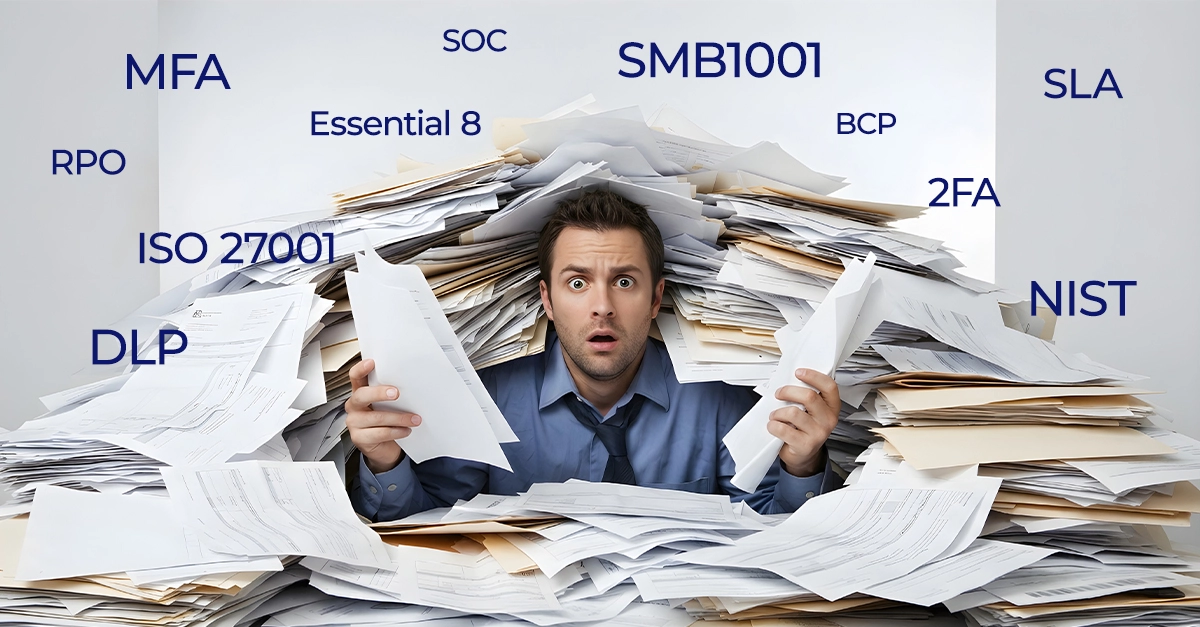
Jargon and acronyms overwhelming a business owner comparing managed IT security services in Cairns

Bring a short list of direct questions to the first conversation, and treat vague answers as a red flag.

Knowing what to look for is one part of it. Knowing how to run the full conversation confidently is the other.

WHAT ARE THE SIGNS A PROVIDER ISN’T THE RIGHT FIT FOR ME?

Vague answers about response time, no plan for extended outages, and pressure to sign quickly are the clearest signs to walk away.

A support line that routes through a call centre with no continuity tells you more than their marketing does. So does a provider who deflects a question instead of answering it, or one who pushes you to sign before you’ve worked through your own list.

If your last provider left you with one of those gaps, you’re not the first business in this region to have had that experience. It’s a common pattern, and it’s fixable.

WHAT DOES MANAGED IT SECURITY SUPPORT LOOK LIKE?

It looks like monitoring that runs before breaks, and a provider who knows how your business operates during a regional weather event.

Security Built Before the Breach

TARDISS Support Services, an NDIS provider operating across North Queensland, needed a stronger cyber security foundation against phishing, ransomware, and the compliance demands of handling sensitive client data. ADITS implemented CyberShield, covering identity and access, staff training, 24/7 monitoring, and documented breach response, aligned to SMB1001 Silver.

The result was a baseline TARDISS could stand on, with reduced risk and clear procedures for when something did happen.

Read the full case study

That’s the shift worth aiming for. Reactive support waits for the call. Managed IT security support is already watching before the call happens.

SUMMARY

If a phishing scare, a slow callback, or a provider who’s never sat through a cyclone warning with you is what brought you here, this isn’t your first attempt at getting IT security right. It’s your second, and that’s exactly why you’re reading a checklist instead of a sales page.

Run the filter above through your next conversation and treat a vague answer as your signal to keep looking. You’ve already done the hard part, working out what went wrong last time. Explore what reliable managed IT security looks like through ADITS’ managed IT security services for your Cairns business, or start with a broader IT consulting conversation if you’re weighing up your setup before committing to anything specific.


Comparing Managed IT Service Providers in Brisbane – Spotting the Orange Dressed as an Apple

Quick Summary

Comparing managed IT quotes is harder than it looks because providers rarely include the same things for the same price. Before you sign anything, ask the same six questions of every provider on your shortlist, check what’s included in the price rather than just the number itself, and weigh up whether a local Brisbane provider genuinely matters for how your business operates.

Three quotes on the desk all for managed IT, all supposedly comparable. One’s $800 a month cheaper. It’s natural to assume that one’s either a bargain or a corner-cutter, but you can’t tell which, because none of the three quotes cover the same things.

That’s the part missing from most advice on comparing providers. You’re not choosing between three versions of the same product. You’re choosing between three different products dressed up as apples to apples, when it’s really apples to oranges .

What Should I Look for in a Managed IT Provider?

Provider A includes after-hours support in the base price. Provider B bills it separately. Provider C leaves it out of the quote entirely, and you don’t notice until your email server goes down at 9pm on a Saturday and you find out the hard way. Same category, three different products.

So before you sign anything, put the same six questions to every provider on your shortlist, and write the answers down side by side.

The Six Questions Worth Asking Every Provider

  • How fast do they respond in practice, not what the contract promises?
  • Have they worked with a business your size, in your industry, before?
  • What does the first month of onboarding involve, in specifics?
  • Is after-hours support in the price or billed separately?
  • Can they connect you with a Brisbane client directly?
  • If things don’t work out and you want to find a new provider, what does that look like?

The answers won’t all sound equally confident. A provider who’s vague on after-hours support is telling you something a proposal never would.

Locked In and Locked Out

Australian Veteran Health Services came to ADITS already locked into their previous provider’s infrastructure, with almost no visibility over their own systems. Over six months, ADITS migrated them onto Microsoft 365 and Azure, and rebuilt their cyber security foundations from the ground up. The result was a team that could finally see and manage its own environment, rather than depending on someone else’s word for it.

visual representation of “different product with a lower price tag”. Apple next to an orange. Orange has a yellow “REDUCED” fruit sticker on it

How Do I Know If Managed IT Pricing Is Fair?

Fair isn’t a number. It’s what’s sitting inside the number. A managed IT agreement worth the price covers monitoring, a helpdesk, patching and basic cyber security as standard inclusions, not optional extras bolted on later.

When a quote comes in well under the others, check what’s missing before you check what you’re saving.

What A Fair Quote Actually Includes

A fair quote isn’t defined by its bottom line, it’s defined by what’s inside it. Check for these before you compare the number itself.

  • Monitoring and patching, standard in almost every quote
  • Helpdesk support, standard, though response hours vary more than people expect
  • Basic cyber security, should be standard, but often appears as an optional add-on
  • After-hours support, frequently billed separately or left out completely
  • Strategic advice, usually the first thing missing when a quote is priced to win the job, not to serve the business

If two or three of these are missing from the quote that looks cheapest, that’s not a bargain. That’s a different product with a lower price tag.

I’ve watched a business save four hundred dollars a month on paper, then lose several times that the first weekend their system went down and the “included support” turned out to have a fine-print exclusion. The saving was real, but so was the gap it left. What managed IT typically costs in Brisbane is worth reading before you compare quotes, so you know which line items to check for on all three.

How Do I Choose the Right Managed IT Provider in Brisbane?

Once you’ve laid the quotes out properly, the real differences tend to surface fast. At that point the decision stops being about price and starts being about fit. A provider who responds in four hours but explains everything in acronyms isn’t the right fit, even if the SLA reads perfectly on paper.

Local matters here in a specific way. A Brisbane-based provider can be on site the same day, has weathered a wet season outage before, and can hand you a reference you can call this week.

If your operation runs mostly online and rarely needs someone in the room, that specific advantage matters less to you, and it’s worth being honest about which one you are before you weight it in the decision.

 Image of the Rocklea Fruit Market to convey local vibes.

Summary

Lay the quotes out properly first. Sorting good managed IT quotes from average ones isn’t that different to picking a decent crate at Rocklea Markets, you’re checking what’s underneath, not just what’s on top. Once you can tell which one’s the good apple, the right answer tends to be clear. If you’d like a second set of eyes on what you’re looking at, ADITS’ managed IT team in Brisbane is a reasonable place to put that in front of someone directly.

IT services Brisbane businesses from Bardon to Newstead can count on

I have been in enough Brisbane businesses to know that no two look the same under the hood. The trades company in Rocklea runs nothing like the accounting firm in Newstead. The medical practice in Bardon has obligations that the hospitality operator in the Valley has never heard of. That is just how this city works.  

Brisbane IT services have come a long way. There is genuine capability here, from managed IT and cyber security through to consulting and cloud migration. The question is not whether what you need exists. It is finding a provider who understands your Brisbane building, not just the technology inside it. 

What it services are actually available to Brisbane businesses? 

Brisbane businesses have access to the full range of IT services you would find in any capital city, from day-to-day helpdesk support through to fully managed IT, cyber security, cloud infrastructure, and strategic consulting. 

The question worth asking is not what is available. It is what is right for your size, your industry, and the way your business actually operates. 

What does managed IT services mean for my Brisbane business? 

Managed IT services mean your IT is looked after proactively, not just repaired after something stops working. A managed IT provider monitors your environment continuously and addresses problems before they reach your desk. 

For a Brisbane business running ten to fifty staff, that typically covers helpdesk support, monitoring, patching, backups, and ongoing management of your devices and network, all on a fixed monthly fee. It is the difference between a call telling you there was an issue and a call telling you there almost was one. 

The break-fix model has a cost that is easy to miss. Every hour your team spends working around a slow system, chasing a password reset, or waiting on a callback is an hour not spent on the actual work. If you want to understand what that shift looks like in practice, managed IT services can enhance business productivity in ways that become obvious quickly once you have made the shift. 

What is the difference between an IT service provider and basic IT support? 

Basic IT support fixes things. An IT service provider manages the whole environment and helps you plan ahead. 

The practical difference shows up under pressure. A provider who knows your environment, your staff, and your setup is already across the context before the conversation starts. They are not reading your systems for the first time at the worst possible moment. They know your building. The distinction matters more than most people realise, what an IT service provider actually covers is worth understanding before you make any decisions. 

Rocklea Markets, a south Brisbane institution and seven minutes from the ADITS office in Salisbury.

Why do local IT services matter for Brisbane businesses? 

Local IT services matter because your business is not generic, and neither is Brisbane. The way a practice in Bardon runs its systems is different to the way a building company in Rocklea does. A provider who has only ever worked remotely does not know that until something goes wrong. By then, the learning curve is your problem to absorb. 

Local also means on-site when it counts. Remote support resolves a large proportion of IT issues quickly and efficiently. But a server migration, a network fault that requires hands-on hardware, or getting fifteen new staff set up before a Monday morning opening, those jobs need a body in the room. 

Which Brisbane industries benefit most from local IT services? 

Every industry benefits from IT that actually fits its purpose. Three come up consistently in Brisbane. 

Healthcare and medical practices operate under strict obligations around patient data, privacy legislation, and compliance accreditation. A practice in Bardon or Ashgrove cannot run on a generic setup from a provider who has never dealt with clinical software or Essential 8 requirements. Bardon Rainworth Medical Centre worked with ADITS over 18 months to move from unreliable, piecemeal systems to a fully managed Microsoft 365 environment with CyberShield deployed across the practice. 

Unreliable IT, growing compliance pressure. All rebuilt in 18 months. 

Bardon Rainworth Medical Centre came to ADITS with unreliable, piecemeal infrastructure and growing compliance obligations. Over 18 months, ADITS transitioned the practice to a fully managed Microsoft 365 environment with CyberShield deployed across the clinic, Essential 8 aligned, and staff working securely from anywhere. 

“I highly recommend ADITS. We started working with the team at ADITS after a referral from another medical clinic and could not be happier. Our IT systems have never been as reliable as they are now, and their friendly staff are always helpful whenever we need them.” 

Leah Mawn, Practice Manager, Bardon Rainworth Medical Centre 

Professional services firms in Fortitude Valley, Newstead, and Toowong carry sensitive client data and operate under compliance obligations that a generic managed IT contract does not naturally account for. A four-partner accounting firm has the same data security exposure as a large firm. It does not need enterprise pricing to get the right level of protection.

Building and construction businesses across the Rocklea and Acacia Ridge industrial belt typically run a split operation. Office staff on Microsoft 365, site crews on mobile devices, foremen moving between jobs across the south side. Keeping that environment secure and connected, without making it complicated for the people on the tools, is a specific problem. I have yet to meet a remote-only provider who solves both halves well.

What are the signs a Brisbane business needs to upgrade its IT services? 

The signals are usually present for a while before anyone acts on them. Watch for these specifically: 

  • Your team works around IT problems rather than reporting them 
  • Your backup has not been tested since the person who set it up left the business 
  • New staff take days to onboard properly, not hours 
  • Your provider only contacts you when something has already broken 
  • Your IT setup has not been reviewed since before the January 2022 Brisbane floods 

That last point carries more weight than it might seem. Brisbane businesses that went through January 2022 know exactly how quickly an untested environment becomes a crisis. If your disaster recovery and business continuity setup has not been looked at since then, it is worth a conversation. 

Why should my Brisbane business choose ADITS for local IT services? 

ADITS has been working with Queensland businesses for over two decades. The Brisbane office sits south of the river, which tells you something about the kind of businesses we work with. Not the Brisbane that appears in the tourism ads. The Brisbane that has a roller door at the front, a receptionist who also does the bookkeeping, and a server cupboard nobody has looked at since 2019. 

What I hear consistently from business leaders who have made the switch is that the difference is not technical. It is relational. They want a provider who knows their name, knows their setup, and picks up the phone when it matters. 

What should managed IT services include for a Brisbane business? 

A well-structured managed IT services Brisbane package covers more than helpdesk support. Monitoring, patching, backups, security, and a named person who knows your environment, those are the foundations. The businesses I work with that get the most value are the ones where IT stops being a separate conversation and becomes part of how the business runs. 

ADITS holds Microsoft partner status, which means the team is trained and certified on the tools Brisbane businesses actually run day-to-day. More practically, it means when something changes in Microsoft 365 or Azure that affects your business, you hear about it before it becomes a problem. 

How do I choose the right IT support in Brisbane? 

Start with fit, not price. The cheapest provider is rarely the right one when something serious happens, and they are working out your setup for the first time under pressure. 

Look for a provider with demonstrated experience in your industry, a local presence that means on-site is actually possible, and a clear explanation of what is included before you sign anything. The first conversation with ADITS IT support is a stock-take, not a sales call. You will come away with a clearer picture of your current environment regardless of what you decide next. 

Summary 

Reliable IT services in Brisbane exist. Finding the right fit means looking for a provider who understands your industry, knows your setup, and will actually show up when the job needs someone in the room. The technology is rarely the differentiator. The local knowledge is. 

If your current setup has never quite been designed for your business, that is worth addressing. It starts with a conversation. 

How Much Does Managed IT Services Cost in Brisbane?

Managed IT pricing in Brisbane is one of those enigmas where every provider website tells you, “it depends” and then asks you to book a call before giving you any numbers. If you’ve spent time trying to budget for IT support without getting a straight answer, you’re not alone. This article is going to be more useful than that. 

So what do Managed IT services actually cost in Brisbane? What is typically included? And how can you tell whether what you’re paying for is actually worth it? We’re going to tell you. 

What do Managed IT services actually cost in Brisbane? 

For most Brisbane businesses, managed IT services cost between $100 and $250 per user per month, depending on the size of your organisation, the services included, and the level of support you need. 

The range is broad because the market genuinely varies. A 15-person professional services firm has different needs from a 200-seat NFP with multiple locations. But those numbers are a realistic starting point for budgeting, and most small to mid-sized Brisbane businesses will land somewhere within them. 

A standard per-user price typically covers helpdesk access, remote support, device monitoring, software patching, and basic security tools. Think of it as the foundation, the services that keep your team working and your systems maintained day to day. 

What moves the number up or down most significantly is scope. A basic package covering helpdesk support and device monitoring sits at the lower end. Add cyber security, Microsoft 365 management, after-hours support, and compliance requirements, and you move more toward the higher end. The size of your team, your industry, and the complexity of your environment will also shape the final figure. 

Does the size of your business change what you pay?

Yes, but not always in the way a smaller business would expect. Per-user costs can be slightly higher for very small teams, but managed IT is financially viable for businesses well under 50 seats. 

There’s a common assumption that managed IT is priced for large organisations and that smaller businesses pay a penalty for their size. That’s partly true, but the difference is less dramatic than you may think. A team of 20 and a team of 80 will often land within the same per-user range, with the main variable being scope rather than size. 

For businesses in the 20 to 50-seat range, managed IT is generally cost-competitive with the alternative, an internal hire. A full-time IT coordinator in Brisbane costs significantly more annually than a managed IT contract that covers more ground, more hours, and a broader range of expertise. 

What is usually included in a Managed IT Services Package? 

A standard managed IT package typically covers helpdesk support, device monitoring, patch management, basic cyber security, and Microsoft 365 management. Anything beyond that is usually scoped separately. 

Most packages are built around keeping your environment stable and your team supported. That means someone to call when things go wrong, proactive monitoring to catch issues before they cause downtime, and regular maintenance to keep systems updated and secure. 

What a standard package usually includes: 

  • Helpdesk support during business hours (some providers offer 24/7) 
  • Remote monitoring and management of devices 
  • Software and security patching 
  • Microsoft 365 licence management and basic configuration 
  • Antivirus and endpoint protection 
  • Regular reporting on your environment 

What commonly sits outside the scope are things like advanced cyber security tools, compliance-specific configurations, cloud migrations, major infrastructure projects, and on-site support beyond an included allowance.  

How do you know if you’re getting value for what you’re paying? 

Value in managed IT isn’t measured by the line items on an invoice. It’s measured by what doesn’t happen. Downtime avoided, security incidents caught early, and a team that isn’t losing hours to preventable IT problems. 

The instinct when comparing providers is to focus on price. That’s reasonable, but price alone doesn’t tell you much about quality. A better question is, “What does good actually look like day to day?”  

What good managed IT looks like in practice 

What it looks like What it doesn’t
Help available when your team needs it Waiting days for a response
Issues caught and resolved before they cause downtime Finding out a problem after it becomes an outage
Systems patched and data protected as standard Discovering after an incident that something wasn’t covered
One accountable contact who knows your environment Being passed between technicians who have to start from scratch

The Australian Cyber Security Centre consistently highlights that most cyber incidents affecting small businesses are preventable with basic, well-maintained controls. The kind of good managed IT provider should be handling as standard. If your current setup leaves those gaps open, the costs of an incident will dwarf the cost of better support. 

Is cheaper managed IT actually cheaper in the long run? 

Rarely. The real cost of underinvesting in IT support shows up in downtime, security incidents, and the hours your team loses to problems that should have been prevented. 

A lower monthly price is easy to justify at budget time. What’s harder to account for is what happens when things go wrong, and with under-resourced IT support, they go wrong more often and take longer to fix. 

An unplanned outage that takes a team of 20 offline for half a day is a significant productivity loss. A ransomware incident, still one of the most common threats facing Australian SMEs, can mean days of disruption, recovery costs, and potential regulatory exposure. These aren’t abstract risks. They’re the predictable outcome of IT support that isn’t keeping pace with the threats your business actually faces. 

That doesn’t mean the most expensive provider is automatically the best one. It means the right question isn’t “how do I pay less for IT?”  

It’s “What reliable support does my business actually need, and am I getting it?” 

Red flags to watch for when reviewing a managed IT provider 

Price alone won’t tell you whether a provider is worth investment. These are the signs worth pausing on: 

Vague SLAs 

If a contract doesn’t specify response times clearly, that’s a gap that matters when something goes wrong. 

Scope that’s never clearly defined 

“Unlimited support” without a definition of what support covers is a red flag 

No local presence 

Remote-only providers can work well, but for Brisbane businesses, local knowledge, and the ability to be on-site matter 

Lock-in without an out 

Long contracts without clear exit terms are worth scrutinising 

Price that seems too low to be sustainable 

Not all budget providers are poor quality, but a price that’s significantly below market is worth understanding before committing 

What should you look for when comparing managed IT providers in Brisbane? 

Look past the features list and focus on response times, scope clarity, local presence, and whether the provider has genuine experience in your industry. 

Most managed IT providers in Brisbane will describe their services in broadly similar terms. And the same is true if you’re evaluating Townsville IT services. What actually differentiates is what shows up in the detail, and in the conversation, not brochures. 

Questions to ask any provider before you sign 

  1. What are your guaranteed response times, and how are they measured? 
  2. What’s explicitly excluded from the base package? 
  3. Do you have experience supporting businesses in my industry? 
  4. Who will actually be managing our account day to day? 
  5. What does your escalation process look like when something goes seriously wrong? 

These five questions will surface more useful information than any feature comparison, and a provider who can’t answer them clearly is telling you something important. 

What does Managed IT actually cost a Brisbane Business in practice? 

For most small Brisbane businesses, managed IT sits between $2,000 and $8,000 per month, depending on team size and scope. For that investment, the expectation should be a stable, secure, and well-supported environment. 

A 25-person professional services firm paying around $150 per user per month is spending roughly $3,750 per month. For that, they’d typically expect covered helpdesk support, monitored devices, patched systems, Microsoft 365 management, and a clear escalation path for anything serious. 

A 60-person NFP with compliance obligations and multiple locations might pay closer to $180 to $200 per user. More because of the complexity of their environment and the specific requirements of their sector, not simply because they’re larger. 

The pattern across both is the same. Cost is driven by scope and complexity, not just headcount. Understanding what you need and what you don’t is the most useful thing you can do before having a pricing conversation with any provider. 

What does a typical Managed IT setup look like for a Brisbane Medical Practice or NFP? 

Healthcare and NFP organisations in Brisbane typically need more from a managed IT provider than a general small business, not just because their technology is more complex, but because their obligations are. 

A medical practice handling patient records has obligations under the Privacy Act and the My Health Record Framework that a general managed IT package may not automatically address. An NFP managing grant funding and donor data faces its own governance and reporting requirements. 

For these organisations, managed IT isn’t just about keeping the lights on. It’s about making sure the environment is configured to meet those obligations. Access controls, audit trails, data handling practices, and that someone is accountable for maintaining them. 

IT solutions for these sectors tend to include a higher proportion of security and compliance configuration, which is reflected in per-user pricing sitting toward the middle to upper end of the market range. That’s not a premium for its own sake. It’s the cost of doing it properly. 

Summary 

Managed IT pricing in Brisbane is more transparent than most provider websites suggest. The numbers exist, they’re just rarely published. For most small to mid-sized Brisbane businesses, a realistic budget sits between $100 and $250 per user per month, shaped primarily by the scope of the services and the complexity of your environment. 

The more useful question isn’t what managed IT costs. It’s what the right level of support costs for a business like yours. That’s a question worth getting a real answer to before you commit to anything. 

ADITS offers a free initial consultation, not as a sales conversation, but as a practical way to get a number that’s specific to your situation. If you’d like to understand what managed IT would actually look like for your business, that’s a straightforward place to start. 

Why Brisbane and Townsville Businesses Need Managed IT Services

Managed IT services is, at its core, an agreement where an outside team takes responsibility for keeping your technology running. Monitoring, patching, security, user support, strategic input handled on your behalf, for a monthly fee that does not change based on how many things broke that week.  

For NFPs, health practices, schools, and professional services firms across Queensland, that matters more than it might sound. Fewer disruptions and much faster help. Actual protection that does not rely on someone noticing a problem after it has already done damage. The cost argument is real too, predictable monthly pricing beats emergency repair bills every time, which is why a lot of growing organisations treat managed IT services as a business investment rather than an overhead. 

What Are Managed IT Services and How Do They Work? 

The short version: your IT partner watches your systems constantly, fixes things before they fail, and makes sure your technology is set up to support how your business works. Not just keeping the lights on. It is monitoring, maintenance, helpdesk support, security management, and the occasional honest conversation about where your infrastructure is headed. For Brisbane and Townsville organisations, the practical difference is fewer outages, fewer surprises, and technology that stops being the thing that slows everything else down.

What are managed IT services in simple terms? 

Someone is watching your systems around the clock, keeping things patched and healthy, and picking up the phone when your staff need help. Problems get caught early. Downtime drops. And your technology stays aligned with what the organisation needs, rather than slowly drifting behind it. 

What Is Included in Managed IT Services? 

What gets covered varies by provider and agreement, but most solid managed IT arrangements include: 

  • 24/7 system monitoring: continuous performance checks across devices, servers, and networks 
  • IT support and helpdesk: fast user support for issues, requests, and troubleshooting 
  • Cyber security protection: endpoint, email, patching, and threat prevention controls 
  • Cloud and Microsoft 365 management: licences, Teams, SharePoint, Exchange, and access controls 
  • Backup and disaster recovery: automated backups and recovery planning 
  • Strategic IT consulting: budgeting, lifecycle planning, and roadmap alignment 

For organisations wanting a deeper local example, this Brisbane managed IT services guide expands on how these services support business continuity and growth. 

What Is the Difference Between Managed IT Services and Traditional IT Support? 

Break-fix is exactly what it sounds like. Something breaks, you call someone, they fix it, you pay. It feels simple until you start adding up what those calls actually cost, not just the invoice, but the hours of lost productivity while your team waited, the work that backed up, the client who noticed your system was down before you did. Managed IT services flips the model. The work happens before the failure, not after it.  

Break-fix arrangements can look appealing on paper because there is no ongoing cost when nothing is broken. In practice, the gaps between incidents are often when problems are quietly building. Security patches going unapplied. Ageing hardware getting closer to failure. Those gaps accumulate and eventually they show up at the worst possible time. 

Why Do Brisbane and Townsville Businesses Need Managed IT Services Today? 

IT is not a back-office function anymore. It affects whether a patient gets timely care, whether a school can run its learning platform, whether a consultant can access client files offsite, whether a charity can process donations without interruption. The organisations that feel this most acutely are usually the ones without a dedicated IT team or with one person wearing three hats. Managed support gives those organisations access to a full team of specialists without the cost of employing them, and it means someone is always watching the systems even when no one is in the office. 

Why Are Managed IT Services Important for Small and Mid-Sized Businesses? 

Smaller organisations carry a disproportionate share of the burden when IT goes wrong. Here is why that is, and what managed support changes: 

  • Limited in-house expertise: internal teams often cannot cover cyber security, cloud, support, and infrastructure at scale 
  • Better cost efficiency: predictable monthly pricing reduces surprise repair and downtime costs 
  • Access to specialists: businesses gain broader expertise across Microsoft 365, cyber security, networking, and compliance 
  • Scalable support: services grow with staff, students, locations, or service demands 
  • Reduced leadership burden: executives spend less time managing IT issues and vendors 

How Do Managed IT Services Improve Cyber Security and Reduce Risk? 

Ransomware does not ask how big your organisation is before it encrypts your files. Phishing emails land in healthcare inboxes and NFP inboxes just as readily as corporate ones. The difference is that smaller organisations often have less protection in place, and less capacity to recover when something gets through. Managed IT services builds that protection layer, monitoring for threats continuously, filtering out malicious email, keeping patches current, controlling who has access to what, and making sure backups exist and can be restored when needed. It also helps organisations understand where they sit against their compliance and governance obligations, which matters especially in healthcare and education. 

For organisations wanting a deeper local view, this Brisbane managed IT services guide fits naturally here as supporting insight into how cyber maturity and proactive support work together. 

How Do Managed IT Services Reduce Downtime and Improve Productivity? 

Systems rarely fail without warning. There is usually a build-up: a device slowing down, a server running hot, a backup that has not been tested in six months. The problem with reactive support is that nobody checks on those things until they become a crisis. Continuous monitoring means someone is looking at that data all the time, and issues get resolved while they are still minor.  

Beyond preventing outages, keeping devices, networks, Microsoft 365, and cloud platforms properly optimised means staff just get more done. A nurse who is not waiting for a slow system to load patient records. A teacher whose video call works. A consultant who can pull up files from the road without hassle. These things add up across a working week. 

What Are the Biggest IT Challenges Businesses Face in Brisbane and Townsville? 

Queensland businesses outside the major CBDs face a particular challenge: finding good IT people is hard, and keeping them is harder. The talent pool for skilled IT professionals in regional areas is genuinely thin. Meanwhile, cyber threats do not care about geography, infrastructure ages whether anyone is managing it or not, and the expectation from clients and regulators around data security keeps rising regardless of where you are based.  

Take a Townsville construction firm running on a mix of older systems that have never quite been consolidated. During a quiet period it is manageable. During peak project delivery, a system failure does not just mean calling IT, it means delayed approvals, missed deadlines, and conversations with clients you would rather not have. Managed IT services does not eliminate every risk, but it significantly reduces the likelihood of the preventable ones, which tend to be the majority.

How Do You Choose the Right Managed IT Services Provider?  

Most people start with price. That is understandable but it tends to lead to poor decisions, because the cheapest managed IT option and the most appropriate one are rarely the same thing. What you actually want to understand is whether this provider has worked with organisations like yours before, how fast they respond when something goes wrong at 7am on a Monday, and whether their cyber security capability is genuinely mature or just ticked on a service sheet. The right partner does not feel like a vendor. They feel like an extension of your team who happens to know a lot more about IT than you do. 

What Should You Look for In a Managed IT Provider in Brisbane or Townsville? 

Beyond the technical basics, here are the things that separate a provider worth committing to from one that looks fine until something goes wrong: 

  • Local expertise: understands Brisbane and Townsville business environments and support expectations 
  • Fast response times: quick issue resolution reduces downtime and operational delays 
  • Industry experience: healthcare, education, NFP, and professional services knowledge improves outcomes 
  • Scalable solutions: support grows with users, locations, cloud adoption, and compliance needs 
  • Cyber maturity: strong prevention, backups, and incident response capability 

What Questions Should You Ask Before Choosing a Managed IT Provider? 

When you are shortlisting providers, these are the questions that tend to separate the good from the average: 

  • What is included in your managed IT support? 
  • Do you offer 24/7 monitoring and proactive maintenance? 
  • How do you handle cyber security incidents and recovery? 
  • Can your services scale as our organisation grows? 
  • What response times and escalation paths do you provide? 

A provider who struggles to answer these clearly is telling you something important before you have even signed anything. 

Why Do Businesses Switch from In-House IT To Managed IT Services? 

Usually it comes down to one of two things: cost or capability. Keeping a full in-house IT team across cyber security, cloud management, infrastructure, and day-to-day support is expensive, and for many organisations it is simply not justified at their scale. Others have an internal person or small team who are genuinely good at what they do, but are being stretched across too many areas to do any of them well. Moving to a managed model lets that person focus on what matters most to the business, while a broader team of specialists covers everything else. 

What Industries Benefit Most from Managed IT Services in Australia? 

Managed IT support is useful across most industries, but the organisations that tend to get the most out of it are the ones where an IT failure has consequences that go beyond the IT team: 

  • Healthcare: secure systems, cyber protection, and high availability for patient continuity 
  • Professional services: reliable collaboration, Microsoft 365, and data security 
  • Education: scalable support across staff, students, and learning platforms 
  • Non-profits: predictable costs, stronger governance, and limited internal IT burden 

Build a More Reliable IT Foundation for Growth 

Technology either supports how your organisation grows or it creates friction that holds everything back. For most Brisbane and Townsville businesses, the difference comes down to whether someone is actively managing it or just reacting when things go wrong. A good managed IT partner changes that equation — your systems run better, your team works without interruption, and leadership gets its time back from chasing IT problems. 

If your business is looking to improve IT reliability, reduce operational risk, and create predictable technology support, ADITS can help align the right managed services model to your growth goals. 

Reliable Managed IT Support for Brisbane Businesses

Brisbane organisations operate in a fast-moving environment where technology reliability directly affects service delivery, compliance, and growth. Managed IT support in Brisbane helps businesses shift from reactive problem-fixing to proactive technology management, which reduces disruption before it impacts staff or clients.  

Rather than waiting for systems to fail, managed support focuses on stability, planning, and continuous improvement aligned with organisational goals. For NFPs, healthcare providers, education institutions, and professional services firms, this approach allows internal teams to stay focused on outcomes while experienced specialists oversee day-to-day IT performance, risk management, and long-term technology direction. 

Why Brisbane Businesses Choose Managed IT Support 

Managed IT in Brisbane has become a useful option for businesses in many fields that depend on technology but don’t need big internal IT departments. Managed IT Services give you predictable support, organised maintenance, and strategic advice without the need to hire specialised teams in-house. This model helps businesses stay compliant with data protection and other standards while making their operations more resilient. 

Outsourcing IT also helps growing businesses stay on track by keeping an eye on systems, planning updates, and dealing with risks early. Managed IT solutions in Brisbane give businesses a structured framework that helps them be more productive, stable, and grow in a way that lasts, instead of just reacting to technical problems. 

Common IT Challenges Faced by Brisbane Businesses 

Many Brisbane organisations face similar technology pressures regardless of industry. Cybersecurity threats continue to evolve, placing sensitive client, patient, or student data at risk if systems are not actively monitored. Unexpected downtime can interrupt services, delay operations, and impact trust with stakeholders. 

At the same time, limited internal IT resources often mean existing staff are stretched between daily support and strategic planning. Without dedicated expertise, issues are resolved reactively rather than prevented. Managed IT support helps address these challenges by providing continuous oversight, structured processes, and access to specialised knowledge that smaller internal teams may not have. 

Why Local Managed IT Support Makes a Difference 

Local managed IT support offers more than just technical help. Providers in Brisbane can respond more quickly when problems come up, which means less disruption to daily business. Knowing how local infrastructure, connectivity, and common regional problems work makes it easier to find and fix problems.  

Regulatory awareness is just as important, especially for healthcare, education, and NFP organisations that need to meet Australian standards for data protection and compliance. Working with a local partner also makes communication better, which means that the advice you get is more useful because it is based on how Brisbane businesses really work instead of on general support models. 

Top Reasons Brisbane Businesses Prefer Managed IT Services 

Brisbane organisations increasingly choose managed IT services because they provide structure, predictability, and long-term reliability.  

Key benefits include: 

  • Predictable IT costs, making budgeting easier without unexpected repair expenses 
  • Reduced downtime through proactive monitoring and preventative maintenance 
  • Stronger cybersecurity, helping protect sensitive organisational data 
  • Scalable IT infrastructure that grows alongside business needs 
  • Local expert support that understands regional compliance and operational challenges 

For organisations exploring structured support options, learn more about ADITS managed IT services. 

The Benefits of Outsourcing IT Support in Brisbane 

Companies can get structured IT help without having to pay for and manage an internal team by outsourcing it. Managed IT solutions in Brisbane offer constant supervision, strategic planning, and dependable IT solutions that help with daily tasks and lower the chance of problems. Businesses get a proactive approach instead of just reacting to technical problems. This makes things more stable and helps them expand over time. Outsourcing gives NFPs, healthcare providers, schools, and professional services peace of mind that their systems will be secure, compliant, and in line with their values. 

How Managed IT Support Improves Business Efficiency 

Managed IT assistance makes things run more smoothly by stopping problems before they happen. Proactive monitoring finds performance problems early, so changes can be addressed before employees have to deal with slow systems or outages.  

Regular system optimisation makes sure that software, devices, and networks run at their best, which helps teams get their work done without any extra delays. Employees can focus on their main tasks instead of fixing technology problems when there are fewer interruptions. Over time, this systematic approach helps the whole organisation function more smoothly, collaborate better, and have technology that works more reliably. 

Cybersecurity and Risk Management Advantages 

Managed IT support strengthens organisational security by combining prevention, protection, and recovery planning into a structured approach: 

  • Threat detection – continuous monitoring helps identify unusual activity early, reducing the likelihood of security incidents escalating 
  • Backup strategies – secure, regularly tested backups ensure important data can be recovered quickly if systems fail or are compromised 
  • Business continuity – clear recovery processes help organisations maintain operations and minimise downtime during unexpected disruptions 

Cost and Resource Benefits of Managed IT Services 

Managed IT services help organisations control costs while gaining access to broader technical expertise. Instead of investing in recruitment, training, and retaining specialised staff, businesses benefit from reduced hiring and operational expenses. This model also provides access to a wider range of specialist skills, ensuring support across cybersecurity, infrastructure, and system management without expanding internal teams. For many Brisbane organisations, this creates a more sustainable approach to technology management. Learn more about what managed IT services involve here 

When Should a Brisbane Business Invest in Managed IT Solutions? 

Many organisations wait until technology problems become disruptive before seeking support, but managed IT solutions are most effective when introduced proactively. As systems grow more complex and compliance expectations increase, Managed IT Services help organisations maintain stability while planning for future needs.  

For Brisbane organisations experiencing growth or increasing reliance on technology, managed support provides structure, guidance, and consistency that internal teams alone may struggle to maintain. 

Signs Your Business Needs Managed IT Support 

Brisbane organisations often recognise the need for managed IT support when recurring challenges begin affecting operations.  

Common indicators include: 

  • Frequent IT issues that interrupt productivity or delay service delivery 
  • Business growth or expansion creating increased technology demands 
  • Security incidents or rising cyber risks that require stronger protection measures 
  • Compliance concerns, particularly in healthcare, education, or NFP environments 
  • Limited internal IT expertise, leaving staff stretched between support and strategic work 

Managed IT Support vs IT Consulting Explained 

IT support and IT consulting are two different yet complimentary services. Managed IT Services are all about providing ongoing operational support, including keeping an eye on systems, making sure they work well, and fixing problems when they come up in the course of doing business. On the other hand, IT consulting gives businesses strategic advice on how to plan technology upgrades, improvements, or long-term digital direction. Combining these methods helps a lot of businesses in Brisbane.  

If you want to understand how strategic planning fits alongside managed support, explore ADITS’ IT consulting services here. 

Speaking with a Local Brisbane IT Partner 

For many organisations, the next step is simply having a conversation with a local expert to evaluate current systems and future needs. A discussion with a Brisbane IT partner allows businesses to identify risks, clarify priorities, and understand available support options without pressure or obligation. This early evaluation helps decision-makers determine whether managed IT support aligns with organisational goals and operational challenges. You can start the conversation or request guidance by contacting the ADITS team. 

Why Your Townsville Business Needs Professional IT Support

Townsville’s economy is built on a mix of small to mid-sized enterprises, healthcare providers, educational institutions, construction firms, and professional services. 

Many of these organisations rely on technology every hour of the working day, yet IT is often treated as an afterthought. Professional IT support provides the backbone for stable operations, secure systems, and staff productivity. 

For organisations in regional Queensland, local knowledge matters. Providers of IT support in Townsville understand connectivity challenges, compliance pressures, and the realities of running a business far from major capital cities. 

What Local IT Support Looks Like in Townsville 

Professional IT support in Townsville is shaped by regional conditions, workforce size, and the need for practical, responsive service rather than abstract technical solutions. 

What Professional IT Support Means for Townsville Businesses 

Professional IT support refers to structured, ongoing assistance that keeps systems running smoothly and securely. In the context of Townsville, this means supporting offices with limited in-house IT staff, ageing infrastructure, and mixed on-site and remote teams. 

Unlike reactive fixes that only address problems after failure, professional support focuses on prevention through system monitoring, updates, and maintenance. This includes managing IT infrastructure, responding quickly to incidents, and ensuring systems align with business needs. Reliable IT support services help local organisations avoid disruption while staying compliant and operational. 

Core IT Services Commonly Included in Professional Support 

Most managed IT services Townsville businesses rely on include a consistent set of practical functions. 

  • Day-to-day system support: Covers desktops, laptops, printers, and networks to reduce staff downtime. 
  • Cybersecurity services: Includes firewalls, antivirus tools, and staff awareness training to limit human error. 
  • Cloud platforms (including Microsoft 365 environments): Support email, collaboration, and document management across multiple locations. 
  • Backup and disaster recovery planning: Ensures data can be restored after hardware failure, cyber incidents, or natural events. 

Together, these IT solutions Townsville organisations use form a stable foundation for their daily operations. 

IT Support vs IT Consultancy vs Managed IT Services 

IT support focuses on operational stability by resolving issues and maintaining systems. IT consultancy Townsville services are more strategic, helping organisations plan upgrades, assess risks, or design new systems. IT managed services Townsville providers offer a combination of both through fixed-scope, ongoing management of IT environments. 

Many Townsville organisations turn to IT consulting alongside support teams during growth phases, compliance reviews, or major technology changes. Understanding the difference helps decision-makers choose the right mix of services without paying for unnecessary complexity. 

Trending Google PAA Questions About IT Support in Townsville 

Local searches for IT support in Townsville often include these questions: 

What does IT support do for a business? 

IT support keeps a business’s technology running reliably and securely. It handles day-to-day technical issues, maintains systems, manages updates, protects data, and responds to incidents so staff can work without disruption. 

Do small businesses need IT support? 

Yes. Small businesses often rely heavily on technology but lack in-house IT staff. Professional IT support helps prevent downtime, reduces security risks, and ensures systems remain compliant and fit for purpose as the business grows. 

What’s the difference between IT support and managed IT services? 

IT support is typically reactive and maintenance-focused, fixing issues as they arise. Managed IT services in Townsville are proactive, providing ongoing monitoring, preventative maintenance, security management, and strategic oversight. 

Why Townsville Businesses Should Invest in Professional IT Support 

Investing in professional IT support is less about technology and more about protecting people, data, and service delivery across the organisation. 

Local Business Risks Without Professional IT Support 

Operating without professional IT support exposes Townsville organisations to avoidable risks. Unplanned downtime disrupts services, delays patient care, or halts learning. Data loss can affect your reputation, resulting in lower client trust. It can also affect your organisation’s regulatory compliance. 

Many regional businesses lack dedicated in-house IT staff, so they become more reliant on informal fixes. National bodies such as the Australian Cyber Security Centre (ACSC) report rising cyber incidents across small and medium organisations, while Australian Bureau of Statistics (ABS) data highlights the growing cost of operational disruption. Without structured IT support, these risks become harder to manage. 

Security, Continuity, and Risk Reduction Benefits 

Professional IT support plays a central role in reducing security exposure. Regular patching, monitoring, and access controls lower the chance of cyber incidents. 

Cybersecurity awareness training on phishing, password management, and device use reduces common entry points for attacks. Business continuity and backup planning ensure systems and data remain accessible during outages or emergencies. 

For healthcare, education, and NFP organisations, these practices support compliance obligations and work to protect sensitive information. 

How IT Support Enables Business Growth and Flexibility 

Reliable IT support allows Townsville organisations to grow without constant technical setbacks. 

Cloud services make it easier to scale staff numbers, support remote work, and adopt new digital tools. Stable systems free leadership teams to focus on service delivery rather than troubleshooting. 

When IT governance and business continuity are managed properly, technology becomes a practical enabler rather than a cost centre that only draws attention during failures. 

Common Questions Townsville Businesses Ask Before Choosing IT Support 

When should a business engage professional IT support? 

A business should engage IT support in Townsville as soon as technology becomes critical to daily operations, often before recurring issues, security concerns, or compliance requirements start affecting productivity or service delivery. 

Can IT support help reduce downtime and cyber risk? 

Yes. Regular monitoring, timely updates, backups, and staff security awareness significantly reduce system failures and the likelihood of cyber incidents, helping businesses avoid costly disruptions. 

Is local IT support better than remote-only providers? 

For many businesses, local IT support offers faster response times, on-site assistance when needed, and a better understanding of local infrastructure and regulatory requirements compared to remote-only providers. 

Brisbane Managed IT Services: Your Complete Guide

Brisbane managed IT services are a way of outsourcing the operation, monitoring, and support of a company’s IT infrastructure by an external IT service provider, sometimes known as a managed service provider or MSP. 

For Brisbane businesses, especially SMEs and mid-market organisations, partnering with a managed IT services provider opens up access to expert support, proactive maintenance, and enhanced security without the need for an in-house team. 

This approach has become increasingly relevant as businesses seek scalable and flexible solutions to keep pace with evolving technology and cyber security demands in the competitive Brisbane market. 

What Are Managed IT Services and How They Work 

How Brisbane Businesses Benefit from Managed IT Services 

With managed IT services, an external company takes care of your IT infrastructure, which includes computers, networks, and software. Providers of these services are sometimes referred to as managed service providers or MSPs. 

Unlike ad-hoc IT support, which only steps in when something goes wrong, managed services offer continuous and proactive service monitoring, maintenance, and support. 

This helps your systems run smoothly and means issues can be identified before they cause disruption. These benefits make managed IT service providers in Brisbane a reliable and strategic solution for local businesses. 

Core Functions Typically Covered by Managed IT Services 

Managed IT services cover several essential functions to keep businesses operating securely and efficiently. 

Proactive monitoring and maintenance ensure IT systems are continuously checked for issues, allowing potential problems to be addressed before they affect productivity. 

Cybersecurity management involves providers implementing strong security measures and delivering user awareness training to help staff recognise threats such as phishing or malware. 

Brisbane managed IT services also support cloud platforms and Microsoft 365 environments. This enables seamless collaboration, secure file storage, and access to productivity tools from anywhere. 

Backup and disaster recovery planning are also included in Brisbane IT services to ensure that business data remains protected and systems can be quickly restored in the event of unexpected disruptions. 

Managed IT Services vs IT Consulting vs Internal IT 

Managed IT services focus on the operational side, handling day-to-day IT management, maintenance, and support so businesses can run smoothly. 

In contrast, IT consulting provides strategic guidance. In this way, Brisbane IT consultants can help organisations plan for growth, adopt new technologies, or address complex challenges. 

Internal IT teams often manage both operational and strategic functions. However, they may lack the expertise of external specialists. 

Brisbane businesses engage IT consultants alongside managed services for projects like digital transformation or cybersecurity upgrades. In this way, they benefit from both ongoing support and targeted, high-level advice. 

Trending Google PAA Questions About Managed IT Services 

What are managed IT services used for? 

Managed IT services are used to monitor, maintain, secure, and support business technology systems to ensure smooth daily operations and uptime. 

Are managed IT services worth it for small businesses? 

Yes, managed IT services are often worth it for small businesses since they offer reliable and professional support, enhanced security, and predictable costs. 

What’s included in managed IT services? 

Managed IT services include monitoring, updates, patching, backups, cyber security, help desk support, cloud management, and strategic IT planning. 

Why Brisbane Businesses Use Managed IT Services & How to Choose a Provider 

Why Managed IT Services Matter in Brisbane’s Business Environment 

Brisbane managed IT services play a significant role in the local business environment due to local factors, such as the rise of hybrid work models, increasing compliance requirements, cyber risk, and ongoing skills shortages. These challenges require targeted expertise and knowledge to maintain secure and efficient operations. 

Industries such as professional services, healthcare, education, and not-for-profits benefit from tailored IT solutions that boost productivity, safeguard sensitive data, and ensure regulatory compliance. By collaborating with managed IT service providers in Brisbane, local businesses can adapt to change and maintain a competitive edge in a dynamic landscape. 

Cyber Security, Continuity, and Risk Reduction 

Managed IT services are essential for strengthening cyber security to ensure business continuity and reduce risk for Brisbane organisations. 

By proactively monitoring systems and swiftly addressing threats, managed providers help minimise downtime and reduce the risk of security incidents. They also implement robust backup and disaster recovery plans to protect data and keep it accessible. 

Brisbane IT services can also offer regular user education and cyber security training, raising awareness of human-related risks such as phishing. This empowers staff to recognise and respond to threats, further enhancing their organisation’s security. 

What to Look for When Selecting a Managed IT Provider in Brisbane 

When choosing Brisbane IT consultants or managed providers, look for a strong local presence and rapid response capability to ensure timely support when issues arise. 

Seek providers with a security-first service framework that incorporates robust compliance and IT governance practices, safeguarding sensitive data and maintaining regulatory standards. 

An effective provider should offer transparent reporting and clear accountability, including well-defined service level agreements (SLAs) so you know exactly what to expect. 

Experience across key Brisbane industries, such as professional services, healthcare, education, and not-for-profits, is essential for tailored solutions. Ultimately, a trustworthy partner demonstrates open communication, detailed performance metrics, and a commitment to your organisation’s ongoing success. 

Frequently Asked Question When Choosing a Provider 

How do I choose a managed IT service provider in Brisbane? 

Choose a Brisbane managed IT services provider with proven local expertise, strong security, clear SLAs, transparency, and industry-relevant experience. 

What questions should I ask an MSP? 

Ask about local expertise, strong security, SLAs, and industry experience when selecting a Brisbane IT services provider. 

Do managed IT providers handle cybersecurity? 

Yes, most managed IT providers offer cybersecurity services, including threat detection, prevention, response, and regular security monitoring for businesses. 

What Should You Look for When Selecting a Managed IT Provider in Brisbane?

Technology should enable your business, not slow you down. When your systems run smoothly, every part of your organisation benefits and your team members, customers and stakeholders feel the difference.  

If your operations rely on cloud platforms, remote work capabilities, digital service delivery and continuous connectivity, reliable managed IT support services can strengthen performance and keep your people productive.  

This guide unpacks the impact of managed IT support and key criteria to evaluate providers to help guide your decision making.  

The Role of a Managed IT Provider in Modern Brisbane Businesses 

A managed IT provider proactively supports a business’s daily IT operations on an ongoing basis. Unlike older, break-fix IT support models that only provide assistance when things stop working, managed IT focuses on proactive monitoring, maintenance and improvements.  

Managed IT support (also referred to as IT managed services and co-managed IT) typically includes core services like network monitoring, system maintenance, cyber security, helpdesk support, and data backup and recovery.  

It’s a proactive service model designed to reduce risk and unplanned downtime. 

Key Criteria to Evaluate When Choosing a Managed IT Provider 

If your organisation is exploring managed IT services, it can be helpful to look beyond service lists to find a provider that can understand your industry, local environment and long-term goals.  

The following criteria can help Brisbane organisations assess capability and strategic fit. 

1. Local Presence and On-Ground Support Capabilities in Brisbane 

For Brisbane-based organisations, having technicians close to your office locations can improve service delivery and help you develop stronger partnerships for business continuity.  

While managed IT prioritises proactive maintenance, critical issues can invariably arise. Fast dispatch and rapid response can be vital for minimising downtime, reducing costs and ensuring your team can receive help quickly from familiar technicians. This can be particularly valuable for NFP, healthcare, educational and professional service firms providing essential activities throughout Brisbane CBD and surrounding technology precincts.  

2. Breadth and Maturity of Managed IT Support Services 

A capable provider should offer a comprehensive suite of IT managed services including, but not limited to: 

  • proactive monitoring and alerting 
  • patch and device management 
  • endpoint and identity security 
  • cloud platform administration 
  • cyber security  
  • data backup and disaster recovery 
  • 24/7 helpdesk access 

Service maturity matters just as much as service breadth, so look for a track record of reliable delivery. Identify providers with clear SLAs, target response times, sound workflows and evidence of ITIL alignment.  

What is ITIL? ITIL (IT Infrastructure Library) alignment is best practice for tailoring IT services to support and enable an organisation’s business goals and strategy. Strong managed IT providers typically use ITIL as a toolkit to achieve business objectives, instead of taking a rigid “by-the-book” approach.  

3. Cyber Security Capabilities and Compliance Expertise 

Cyber security has become a non-negotiable component of managed IT support. A quality provider should demonstrate competency in SMB1001 alignment, advanced data protection measures, identity security and vulnerability management.  

For organisations handling sensitive records, like healthcare, education and NFPs, choosing a provider with compliance expertise can be invaluable in reducing operational, legal and reputational risk. 

4. Cloud Experience and Vendor Partnerships 

Your IT may rely heavily on cloud environments like Microsoft 365, Azure, Google Workspace and other industry-specific platforms.  

A managed IT provider with recognised vendor partnerships and designations, such as a Microsoft Solutions Partner status, can offer better support, faster escalation paths and access to advanced tools.  

Overall, cloud expertise can provide your organisation with the best-practice guidance and support with licensing, identity security and platform optimisation. 

5. Transparent Pricing and Clear Contract Structure 

Understandably, you may not want to get caught up in the technology weeds, but support agreements are worth evaluating. Look for transparent pricing and clear contracts.  

Some contracts bury hidden fees, vague deliverables or exclusions that can leave your businesses under-supported. Look for providers that speak in plain language and offer:  

  • fixed, predictable monthly pricing 
  • clear inclusions 
  • reporting cadence 
  • escalation paths 
  • renewal terms 

Transparency can give you greater confidence, and enable your organisation to budget accurately and avoid unexpected expenses. 

6. Proactive Technology Strategy & Digital Transformation Roadmaps 

The best managed IT providers go above and beyond service delivery and day-to-day support. They’ll have a forward focus on uplifting your digital future.  

Your chosen partner can help you define a clear technology strategy and digital transformation roadmap through: IT consulting, quarterly technology reviews, asset lifecycle management, cyber security risk reporting and modernisation planning.  

They may be guided by reputable frameworks, such as the ASD’s Information Security Manual (ISM) and ISO 27001 to design secure, scalable environments.  

How Managed IT Support Services Reduce Operational Risk for Brisbane Organisations 

Effective managed IT services support uptime through incident prevention and security resilience.  

Incident prevention 

Services such as proactive monitoring and endpoint management can reduce the likelihood of outages, helping Brisbane organisations maintain uptime – particularly important for education campuses, NFP offices, mining operations, healthcare clinics and professional service firms.  

Security resilience  

Implementing advanced security controls can protect your organisation against rising, increasingly sophisticated cyber threats, like ransomware and phishing. Additionally, solid backup and disaster recovery plans can restore your systems in the event of unexpected incidents.  

By preventing incidents and establishing strong security protocols, managed IT can protect your organisation’s productivity, essential services and sensitive data.  

Comparing IT Managed Services Providers: Questions Brisbane Businesses Should Ask 


What is the fastest response time for managed IT support in Brisbane? 

Response can vary between providers. Leading providers typically offer rapid support within target response times, as specified in their SLAs.  

How do I know if my business needs a fully managed IT service or a co-managed solution? 

Co-managed can be valuable for organisations needing extra capability or coverage. Fully managed IT is ideal for organisations that lack an internal IT team. Consider getting in touch with ADITS to discuss your requirements.  

What certifications should a reputable managed IT provider have in Australia? 

There are a range of valuable certifications a managed IT provider may hold. Consider certifications such as Microsoft partner status, ISO 9001, ISO 14001 and security certifications such as ISO 27001.  

What are considered standard inclusions in managed IT support services? 

Standard managed IT inclusions typically include monitoring and maintenance, IT support, software updates and patching, backup and recovery and helpdesk support.  

How does a managed IT provider improve business cyber resilience? 

Managed IT providers strengthen cyber resilience by implementing layered security controls, such as access management, secure password management, anti-virus, firewalls, endpoint detection and response and even cyber awareness training.  

Is outsourcing IT more cost-effective than hiring an internal IT manager? 

Oftentimes, yes. Outsourcing IT can provide your organisation with broader expertise at lower, predictable monthly costs. 

What should be included in a managed IT SLA (Service Level Agreement)? 

SLAs should typically define service scope, transparent pricing, clear response times, escalation paths and reporting frequency.  

A Checklist for Selecting the Right Managed IT Provider in Brisbane 

Before committing to a partnership, it can be helpful to assess whether a provider’s core capabilities that align with your organisation’s requirements. Consider whether your shortlisted managed IT provider can demonstrate: 

  • local presence & fast field support 
  • 24/7 help desk availability 
  • comprehensive service coverage 
  • documented processes and SLAs 
  • strong cyber security capabilities 
  • strategic IT planning included 
  • transparent pricing 
  • industry-specific experience  

For Brisbane organisations, this helpful checklist can give you a way to evaluate service scope and fit.  

How ADITS Supports Brisbane Businesses as a Trusted Managed IT Provider 

ADITS has supported Brisbane businesses with reliable managed IT expertise for more than two decades. Our managed services combine local expertise with enterprise-grade technology and security capabilities, strengthened by reputable technology partnerships.  

We have a proven track record of delivering meaningful outcomes for a diverse range of industries, including SMEs, NFPs, healthcare, education and professional services organisations. Learn more about our managed ITcyber security and IT consulting services.  

Choosing a Managed IT Provider That Supports Long-Term Growth 

When you find a managed IT provider that truly aligns with your organisation’s needs, the day-to-day pressures of managing technology fades. A dependable technology partner can be one of the most powerful assets for achieving your goals and growth.  

Make the best choice for your organisation by connecting with a provider that prioritises local expertise, comprehensive services, cyber security capabilities, transparent contracts and proactive technology strategy. 

Ready to strengthen your technology foundation with Brisbane-based managed IT? Explore ADITS’ managed IT services, or get in touch to discuss your technology goals. 

Understanding the different types of Managed IT Services for businesses

Managing your business technology in 2025 is becoming increasingly difficult. From the rapid rise of cloud tools and AI to the growing sophistication of cyber threats, IT environments have never been more complex, or more critical to get right.

Managed IT services for businesses provide a practical solution. By letting experts take care of everything from networks and security to backups, cloud management, and compliance, businesses can focus on growth instead of constantly reacting to tech problems.

Here’s a closer look at the main types of managed IT services, what each does, and how they help businesses run securely and efficiently.

1. Network & infrastructure management

Your network works like the circulatory system of your business, keeping information moving where it needs to go. Everything from email to cloud apps to customer transactions depends on it. If it’s slow, unstable, or set up without the right safeguards, your entire operation can feel sluggish, frustrating and unreliable.

What it does

  • Keeps your servers, routers, switches and wireless networks running smoothly.
  • Monitors performance, availability and security around the clock.
  • Spots potential bottlenecks or hardware issues early, so they’re fixed before they cause real trouble.

How it helps your business

  • Cuts down on expensive outages and the lost productivity that comes with them.
  • Gives staff the speed and stability they need to work efficiently.
  • Grows alongside your business, whether that’s more users, new offices, or expanded online services.

Example

Imagine a business with several branches spread across different cities. Every day, staff need to share large files, jump into video meetings with colleagues, and process customer payments on the spot.

With a fast, secure, and well-managed network, those activities happen effortlessly. Files upload in seconds, video calls stay crystal-clear, and transactions go through instantly. No lag, no dropouts, and no frustrated employees or customers.

2. Patch management & system updates

Keeping your business systems updated might not sound exciting, but it’s one of the most effective ways to keep everything secure, stable and performing well. 

The reason for this is that outdated software can quickly become a weak point. It can cause slowdowns and compatibility issues — and it can even open the door to cyber threats. Staying on top of patching makes sure your business avoids these unnecessary risks.

What it does

  • Regularly installs the latest updates and patches for your operating systems, applications and devices.
  • Ensures software and hardware stay compatible as your IT environment evolves.
  • Closes vulnerabilities before they can be exploited.

How it helps your business

  • Helps you avoid those frustrating crashes or slowdowns that come from outdated systems.
  • Keeps staff working smoothly by making sure the tools they rely on run the way they should.
  • Closes off easy entry points for cyber criminals. This gives you stronger protection without the extra effort.

Example

Imagine ​​a professional services firm that relies on several different programs to keep client work moving. If just one of those tools isn’t updated, it could start playing up, crashing in the middle of a job or leaving the business exposed to risks.

With managed patching in place, updates happen quietly in the background. Staff can keep serving clients without any disruptions. And the business avoids the stress of hidden vulnerabilities lurking in outdated software.

3. Helpdesk & technical support

When technology goes down, even small delays can cost your business. Every minute counts. Waiting for fixes or trying to troubleshoot issues internally can slow your team down and distract from the work that really matters. Helpdesk and technical support services ensure problems get resolved quickly so your business can keep moving.

What it does

  • Provides unlimited day-to-day support through phone, email or remote access.
  • Troubleshoots software glitches, hardware malfunctions and connectivity issues.
  • Responds quickly to cut back on interruptions and restore normal operations.

How it helps your business

  • Keeps downtime to a minimum so your team can stay productive and focused.
  • Builds employee confidence by giving staff fast, reliable support whenever they hit a technical roadblock
  • Lets internal teams concentrate on important projects instead of spending their day troubleshooting IT issues.

Example

Picture a university during enrolment week, when staff are processing hundreds of student applications and payments each day. Suddenly, the enrolment portal crashes and staff are left unable to access records or complete registrations. Stress builds as deadlines loom and students start calling in frustrated.

With managed helpdesk support, however, a technician can step in remotely, identify the issue and restore the access within minutes. Staff get back to processing applications, students don’t miss their enrolment and, best of all, the university avoids a major disruption during one of its busiest times.

4. Backup & disaster recovery

Hardware can break. Cyber attacks can hit. Natural disasters can bring operations to a standstill. Without a strong recovery plan, downtime can quickly spiral into lost revenue, reputational damage, and expensive setbacks.

What it does

  • Creates secure, automated backups of your data and systems.
  • Runs regular tests to make sure recovery processes actually work when it counts.
  • Gets your systems and operations back up and running fast after a data loss incident.

How it helps your business

  • Shields your data from threats like cyber attacks, accidental deletions, or hardware failures.
  • Cuts service disruptions to a minimum with quick, efficient recovery.
  • Gives you confidence knowing your business can bounce back from almost any disruption.

Example

Imagine a busy medical practice that suddenly experiences a server failure. It leaves staff unable to access electronic health records or booking systems. Without fast recovery, consultations would be delayed, patient care interrupted, and compliance risks increased.

A well-prepared disaster recovery plan in place changes everything. The practice can restore its systems from secure backups within hours. That means patient data remains intact, appointments continue without disruption, and doctors can keep focusing on care rather than scrambling to recover lost files.

5. Cloud management

Cloud platforms can do amazing things for your business, from enabling remote work to storing huge amounts of data. With managed IT services for businesses in place, costs stay under control, performance remains strong, and security gaps are minimised.

What it does

  • Manages cloud infrastructure and applications like Microsoft 365, Azure or AWS.
  • Maximises cloud performance and helps control spending.
  • Ensures your cloud environment meets security and compliance standards.

How it helps your business

  • Makes collaboration easy by giving staff secure, remote access to the tools and data they need.
  • Reduces unnecessary costs from unused or misconfigured cloud resources.
  • Keeps sensitive information safe while staying compliant with industry regulations.

Example

Consider a secondary school that shifts its systems to Microsoft 365 to improve collaboration between teachers, students, and administrators. Proper cloud management can allow staff to securely share lesson plans, students to access assignments from home, and administrators to maintain clear control over permissions. 

Plus, files sync seamlessly across devices, data stays protected, and the school meets its compliance obligations. And it achieves all of this while reducing unnecessary IT costs.

6. IT asset management

It’s easy to lose track of all the devices, software licences and IT tools your business uses, especially as your team expands. Without a clear system in place, it’s all too common to overspend on tools you don’t need, keep outdated hardware hanging around, or waste valuable time figuring out where everything is.

What it does

  • Tracks all IT assets across your business, from laptops and servers to software licences.
  • Provides visibility into the lifecycle of each asset, including warranties and replacement schedules.
  • Ensures your team has the right tools in place without unnecessary duplication or expense.

How it helps your business

  • Cuts costs by avoiding overspending on unused or forgotten assets.
  • Improves efficiency by keeping your IT resources up to date and properly allocated.
  • Gives you clarity and control, so you always know what technology you have and how it’s performing.

Example

Think about a professional services firm with staff spread across multiple offices. Without centralised asset management, it’s easy to lose track of laptops, software subscriptions or warranty expirations.

With managed IT asset management, the business has a clear overview of every device and licence in use. This means staff always have the tools they need to serve clients effectively, the firm avoids paying for redundant licences, and technology refreshes happen on time, without last-minute surprises.

Keep your IT working for your business

Managing technology can be complex and unpredictable. With ADITS as your Managed IT partner, you gain a professional team that keeps your systems secure, your data protected, and your business running like a well-oiled machine.

From reducing downtime and improving day-to-day efficiency to aligning your technology with future goals, ADITS provides proactive support so your team can focus on business growth instead of IT annoyances.

So if you’re ready to take the stress out of technology, contact ADITS today and discover how our managed IT services can help your business operate efficiently and confidently.