Safeguarding Your NFP Against Social Engineering Attacks

Australians have been losing $40 million monthly through social engineering scams. The Not-For-Profit (NFP) sector is not spared. While the Australian Charities and Not-for-profits Commission (ACNC) had warned of scams impersonating charities, the Australian Signals Directorate (ASD) confirmed NFPs are “prime targets for cybercriminals.”

Understanding and mitigating threats such as social engineering attacks is crucial for protecting your organisation’s mission and reputation.


What is Social Engineering?

Social engineering is any tactic that manipulates people into divulging confidential information or performing actions that compromise security. Common social engineering methods include:

  • Phishing: Fake emails or messages that appear to come from reputable sources, prompting recipients to click on malicious links or provide sensitive information.
  • Spear Phishing: Targeted phishing aimed at specific individuals or organisations, often using personal information to appear more convincing.
  • Pretexting: Creating a fabricated scenario to obtain information from a target, often by impersonating someone trustworthy.
  • Baiting: Offering something enticing to lure victims into a trap, such as a free download that would actually install malware.

Many of these are done via email, SMS, social media, and messaging apps. A few involve in-person activities, such as tailgating, or gaining unauthorised physical access by following someone with legitimate access.


How Social Engineering Affects Nonprofits

Social engineering attacks can have very serious impacts on an organisation, including:

  • Disruption of Operations: Interruptions to NFP operations and services
  • Financial Loss: Direct theft of funds or costs associated with remediation
  • Reputation Damage: Loss of trust from donors, partners, and the public
  • Legal and Regulatory Issues: Potential fines and legal action due to data breaches

The mental health of employees can also be affected by social engineering incidents. They can cause psychological distress to victims, including guilt, anxiety, fear, loss of trust, and a sense of helplessness. In turn, workplace productivity can decrease.

Additionally, understanding how to protect personal and sensitive information is key to maintaining trust and credibility with your stakeholders. For more insights on this, refer to our article.


Real-Life Cyber Incidents and Social Engineering Attacks on NFPs

The Cancer Council Australia was one of the Nonprofits affected by the data breach at fundraising services provider, Pareto Phone. It exposed names, dates of birth, addresses, email addresses, and phone numbers of donors and stakeholders. In a separate incident, Cancer Council Tasmania advised donors and prospects about hoax emails and website scams asking for donations.

The Australian Cyber Security Centre (ACSC) had also cited social engineering cases involving nonprofits. One involved a charity supporting families in need. Cybercriminals gained access to a staff email that did not use multi-factor authentication. They sent a fake invoice to the finance department and tricked them into sending over $30,000.

In another case, a corporate donor was defrauded via email spoofing. The attackers impersonated a Nonprofit supporting healthcare professionals, using a spoofed email domain ending in “.org” instead of “.org.au”. The corporate donor was convinced to redirect $20,000 to a fraudulent account.


Top Strategies for Preventing Social Engineering

To protect your NFP, consider implementing the following strategies:

1. Employee Education and Awareness

Ongoing training is essential to help employees recognise and respond to social engineering threats. Training should cover:

  • Recognising phishing emails
  • Creating and maintaining strong passwords
  • Understanding the importance of verifying requests for sensitive information

Also, provide employees with ongoing support, regular updates, and other resources to help them stay informed and vigilant.

2. Security Policies and Procedures

Draft clear guidelines to guide staff about their role in maintaining security and what to do when threats arise. Key policies should include:

  • Procedures for verifying the identity of individuals requesting sensitive information
  • Guidelines for handling suspicious emails and messages

To remain effective, you must regularly review and update these policies.

3. Technical Controls

Implementing measures such as below can significantly reduce the risk of social engineering attacks:

  • Email Filtering and Spam Protection: To block malicious emails before they reach employees
  • Multi-Factor Authentication (MFA): Adds an extra layer of security by requiring multiple forms of verification
  • Intrusion Detection Systems (IDS): Monitors network traffic for suspicious activity

4. Incident Response Planning

Having a plan in place for responding to social engineering attacks is crucial. This plan should include:

  • Steps for containing and mitigating the attack
  • Designating a response team for handling security incidents.
  • Procedures for notifying affected parties
  • Regular testing and updating of the plan to ensure its effectiveness
  • Post-incident activities to identify weaknesses and improve future responses

5. Regular Security Audits

Conduct regular audits to identify vulnerabilities and ensure compliance with security policies. Regularly review internal processes and systems for potential security gaps. You may also engage third-party experts to do comprehensive security assessments.

6. Secure Communication Channels

Ensure that sensitive information is communicated only through secure channels, such as encrypted emails and secure messaging apps.

7. Third-Party Security

Ensure that your stakeholders also adhere to strong security practices. Perform partner assessments regularly to evaluate their security practices. Include security requirements in contracts with third parties.

All these strategies can help you build a strong defence against social engineering attacks.


Protect Your Nonprofit Today

With the right strategies, you can protect your organisation against social engineering threats and therefore safeguard your mission. To help NFPs across Queensland, including those in Brisbane, Townsville, and surrounding areas, ADITS has designed a unique approach called CyberShield combining managed IT and essential cyber security services and IT governance. Find out how we can help you today.

Secure Your Mission with CyberShield

What Is a Password Manager and Is It Really Safe?

How many accounts do you have require using a password?

Think of your email (sometimes multiple addresses), social media (too many channels), productivity platform at work, banking and finance, shopping, streaming, entertainment, gaming, education – the list goes on.

Estimates say that the average person could have dozens to hundreds of accounts. No wonder many people simply use the same password for all of them. That’s a risky practice leaving them vulnerable to cyberattacks, data breaches, and identity theft. However, it’s so much easier than having to remember one password for each of your accounts, right?

There is a safer way: Password managers.

What is a Password Manager?

A password manager is like a personal digital vault. It’s an application that stores your usernames, passwords and sometimes two-factor codes for every account in an encrypted format. It requires a user to remember just one master password to access their vault – you no longer need to recall countless login details for various websites and apps.

Why Use a Password Manager?

Password managers are very convenient and save users a lot of time. As they streamline the login process, the stress and frustration that comes from trying to remember login credentials are removed.

You can also enjoy these benefits from using a password manager:

  • Stronger Passwords: Password manager apps help to generate strong, unique passwords for every account. This reduces the risk of brute-force attacks – a trial-and-error method of trying all possible passwords until the correct one is found.
  • Improved Security: Because password managers do not reuse passwords, you become less vulnerable to data breaches and identity theft. Also, secure password management solutions are aligned with the principles of cyber security services and frameworks.
  • Secure Password Sharing: Some password managers allow users to securely share login credentials with their team, which is safer than sharing plain text passwords.
  • Cross-Platform Compatibility: Most password managers work across different devices, ensuring your login information is always accessible.

How Does a Password Manager Work?

Here’s a simplified breakdown:

  1. Installation: You download and install a password manager app on your computer or mobile device.
  2. Creating an Account: You create an account with the password manager, using a strong and unique master password.
  3. Adding Login Credentials: For each website or application you use, simply add the login details (username and password) to your password manager. For new credentials, the password generator feature available in many password managers comes in handy.
  4. Automatic Login: When you visit a website or app, the password manager can automatically fill in your login credentials, saving you time and effort.
  5. Secure Storage: Your credentials are stored in an encrypted format within the password manager’s vault. This makes it extremely difficult for unauthorised individuals to access your data, even if they were to gain access to your device.


Are Password Managers Really Safe to Use?

You may have heard of the LastPass security breaches and wonder ‘Are password managers really secure’? While risk zero doesn’t exist, it is important to note that there was no flaw in the password manager itself. The attackers instead exploited a vulnerability in third-party software and bypassed existing controls.

This should remind us of the importance of strong security measures. Making sure you enforce strict protocols with your vendors and suppliers is as important as password management.

Our CyberShield and CyberShield+ packages have been designed with this approach in mind. Not only they include an enterprise-grade solution that allows seamless integration and management of passwords across the organisation, but they’re also built around managed IT, security controls and governance.

However, it is fair to question that if a breach happened to LastPass, it could happen to any password manager app, so let’s address that by debunking some common misconceptions:

Myth 1: Password managers are not secure.

Reputable password managers are designed to be secure. Advanced encryption technologies make it virtually impossible for hackers to access your data. Many password managers also utilise multi-factor authentication (MFA) for extra security.

Myth 2: If I lose my master password, I lose everything.

Forgetting your master password is inconvenient, but most password managers offer recovery options. It’s essential to follow the provider’s guidelines for setting up recovery methods to avoid losing access to your passwords.

Myth 3: Storing all passwords in one place is risky.

Keys are often placed together in a keyring or a key safe so they’re not scattered around loosely. In a similar way, storing all your passwords in a secure online password manager is safer than managing them manually. Just make sure your password manager enforces strong password generation and prevents password reuse, so that the risk of a data breach impacting multiple accounts is significantly reduced.

Of course, as previously mentioned, there is no risk-free password manager app. The trick is to find the most secure one that adheres to strict security measures and is perfect for your needs. Here are 7 Tips to Choose the Best Password Manager.

Myth 4: Password managers are too complicated to use.

Modern password managers are user-friendly. Many of them offer intuitive interfaces and features that simplify the password management process. For example, Keeper offers a seamless user experience with its autofill browser extension, allowing you to quickly and securely log in to your favourite websites with a single click.

Myth 5: I can remember all my passwords – so I don’t need a password manager.

We can barely remember to bring milk home on our way back from work, so how are we supposed to remember complex, unique passwords for dozens of online accounts? Relying on memory increases the likelihood of using weak or reused passwords, which can be a recipe for disaster.


Take Control of Your Digital Security

The importance of password safety is easy to underestimate or overlook. But data breaches are wake-up calls that highlight the need for a reliable password management solution.

With a secure password manager, you can enhance your online security posture and reduce the risk of cyberattacks.

At ADITS, we believe that in Brisbane, Townsville, and beyond, a secure password management solution is non-negotiable to create a robust defence against increasingly sophisticated threats in today’s ever-changing landscape.

FIND OUT MORE

Why the SMB1001 Cyber Security Framework is Making Waves

The digital revolution has brought not only fantastic opportunities but also increased the attack surface when it comes to threats. Nearly half of Australian SMBs have already been targeted by cyberattacks with the cost of cybercrime averaging between $46,000 to $97,000 for small and medium sized businesses.

These statistics should serve as a wake-up call, highlighting the urgent need for robust cyber protection!

That’s when cyber security frameworks come in. They provide a structured approach to managing cyber risks, ensuring compliance with industry regulations, and incorporating best practices for IT security.

With the many frameworks available these days, this article will delve into the SMB1001 and look at why it is a game changer for smaller organisations.


An Overview of Cyber Security Frameworks

First, it is important to understand that cyber security frameworks provide a common language and methodology for discussing and managing risks. They aim to safeguard your data, systems, and ultimately, your business’ reputation.

Some of the top cyber security frameworks in Australia are ISO 27001, NIST, CIS Controls and the Essential Eight (E8).

The E8 are supported by the Australian Government who developed it through the ACSC back in 2017 to help businesses mitigate cyber threats. While it is not mandatory for private businesses, it is strongly recommended.

After 7 years, we’re able to look back and realise that these traditional frameworks present challenges for smaller organisations that are looking for something less complex, not resource-intensive to implement, and more flexible to suit their needs.

SMB1001: A Clear Path to Cyber Maturity

Dynamic Standards International (DSI) developed SMB1001 to fill the gap in cyber security certification for SMBs.

It addresses the unique challenges faced by SMBs in implementing effective cyber security measures without the complexity and high costs associated with larger, more comprehensive frameworks.

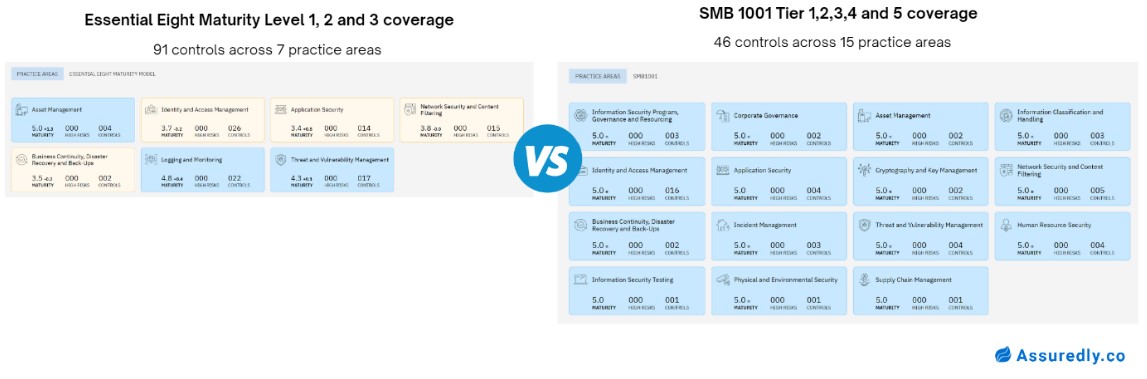
It covers essential security practices across various areas such as incident response, risk management, and employee training, which are often overlooked by simpler frameworks like the Essential Eight.

So, what makes SMB1001 work?

The framework’s certification process is straightforward, practical, and built around five areas of focus:

  • Technology Management – This pillar focuses on managing and securing the technology infrastructure, including hardware, software, and networks. It involves implementing security controls such as firewalls, antivirus software, and intrusion detection systems to protect against cyber threats. Regular updates and patch management are also essential to ensure that all systems are protected against known vulnerabilities.
  • Access Management – This involves controlling and monitoring access to information systems and data. It includes implementing strong authentication mechanisms, such as multi-factor authentication, to ensure that only authorised individuals have access to sensitive information. Access controls should be regularly reviewed and updated to reflect changes in personnel and roles within the organisation.
  • Backup & Recovery – Regular data backups and having a robust recovery plan in place is important. It ensures that data can be restored in the event of a cyber incident, such as a ransomware attack. A well-defined recovery plan helps minimise downtime and ensures business continuity by outlining the steps to be taken to restore systems and data.
  • Policies, Plans, & Procedures – this involves developing and implementing comprehensive cybersecurity policies, plans, and procedures. These documents provide guidelines for the organisation’s security practices and response to cyber threats. They should cover areas such as incident response, data protection, and employee responsibilities. Regular reviews and updates are necessary to ensure that the policies remain effective and relevant.
  • Education & Training – The SMB1001 framework is designed to be clear, concise, and accessible even for those without a deep technical background. This approach can empower your non-technical staff to take ownership of your cyber security posture. Everybody, at all levels, gets the chance to contribute to keeping the organisation protected. The responsibility of cyber security involves the entire organisation:
    • Employees, by following best practices like not opening suspicious emails, using strong passwords, and regularly updating their software.
    • Managers, by allocating resources for cyber security training and tools.
    • Executives, by prioritising cyber security at a strategic level.

SMB1001 vs. The Essential Eight

Both frameworks have the same goal which is to enhance cyber resilience, but SMB1001 provides a more accessible entry point for businesses of all sizes. It also covers more of the key practice areas that support a robust security program.

In the contrary, the E8 requirements are more technical and complex to comprehend, often leaving small business owners confused and not confident enough to continue building out their security posture.

Take Action with a Reliable Partner

ADITS’ cyber security solution, CyberShield, is built around essential security controls outlined by the SMB1001 :23 Silver Tier 2. Take control of your cyber security today – with expert guidance. ADITS can help your business through comprehensive cyber security services in Brisbane and Townsville.

CyberShield Brochure

With data becoming an invaluable asset and stricter rules regarding its protection, we have enhanced our offerings with CyberShield +, an advanced cyber security solution for businesses. It includes everything from CyberShield, plus a cyber security awareness program through uSecure and compliance to the mandatory Privacy Act.

CyberShield+ Brochure

Ensuring Data Security and Compliance with Microsoft 365

Did you know that having cyber security covered doesn’t necessarily mean that requirements for privacy laws are in place?

After a few years of major cyber attacks making headlines, we would hope that there is an increasing understanding of the critical importance of cyber security. However now, the focus needs to also be on data privacy.

Why?

  • Financial services clients want their data to be secure.
  • Patients want Healthcare services to keep their records confidential.
  • Donors to Nonprofits want their personal information properly handled.

Data privacy is about protecting people. Of course, all organisations wish for better security, but not everybody does what is needed for data protection. When it becomes an afterthought, it can lead to the impression that privacy and security are at odds with one another.

However, when done strategically, ensuring data privacy can lead to:

  • Trust and Confidence: When customers are confident that their data is secure with you, they are more likely to do business with you.
  • Regulatory Compliance: Non-compliance with strict regulations can result in hefty fines and legal consequences.
  • Competitive Advantage: Customers are becoming more concerned about data privacy issues, so organisations that prioritise it can gain a competitive edge.

An ally in your quest for better data protection is Microsoft 365. The leader in cloud-based productivity software provides a range of features and practices to help organisations protect their sensitive information. In this article, we’ll look at how Microsoft 365 can help to protect your organisation’s data while meeting rigorous compliance requirements.

Security Features in Microsoft 365

What’s in Microsoft 365 that can help you create a resilient digital environment? Here’s an overview of Microsoft (Office) 365 security and compliance features.

FEATURE* DESCRIPTION ROLE EXAMPLE
Multi-Factor Authentication (MFA) Adds an extra layer of security on top of passwords; users who log in must provide a second form of verification (like a text message or an authentication app) Reduces the risk of unauthorised access; even if a password is compromised, MFA prevents account breaches If an employee’s credentials get compromised, MFA can stop criminals in their tracks.
Microsoft Defender Formerly known as Advanced Threat Protection (ATP), shields against sophisticated cyber threats, including phishing emails, malware, and zero-day attacks Scans attachments and links in emails, blocking malicious content before it reaches your inbox When a staff member receives an email claiming to be from a trusted client and ATP detects a suspicious link, it prevents them from clicking and thwarts a potential phishing attack.
Data Loss Prevention (DLP) Prevents accidental or intentional data leaks, by identifying sensitive information (e.g., credit card numbers, health records) and enforcing policies to prevent unauthorised sharing Ensures that confidential data stays within your organisation, minimising the risk of accidental exposure When an employee tries to email a customer list containing personal details, DLP flags the action, preventing accidental leakage and maintaining compliance.
Information Rights Management (IRM) Allows control over who can access, forward, or print specific documents or emails, encrypting files and restricting actions based on permissions Secures sensitive documents, even when shared externally, so that only authorised recipients can view or modify them When you share a confidential contract with a partner, IRM ensures that they can read it but can’t forward it to others without permission.

*These are all included with a Microsoft 365 Business Premium licence at no extra cost.

Staying Healthy with Microsoft Secure Score

Using Microsoft 365 Secure Score is like having a built-in security health checkup. It evaluates how well you’re protecting your digital assets, including data, devices, and applications. The better your security practices, the higher your score. Secure Score can recommend where you can improve, then you can create an action plan to implement recommended actions.

The Secure Score feature is included in Microsoft 365 Business Premium and available once you start using the suite. You don’t need to set up Secure Score, and you can view it in the Defender for Cloud Overview dashboard. The score automatically updates every day.

Some recent updates to Microsoft Secure Score can further enhance your security posture:

  • Phishing-resistant MFA strength is required for administrators
  • Windows Azure Service Management API is limited to administrative roles
  • Internal phishing protection for Microsoft Forms is enabled
  • SharePoint guest users cannot share items they don’t own

Compliance Capabilities in Microsoft 365

Microsoft 365 supports these compliance standards:

  • ISO 27001: Outlines best practices for information security management systems and helps improve security controls and risk management
  • Health Insurance Portability and Accountability Act (HIPAA): Helps protect healthcare data, controlling access, and maintaining audit trails
  • Australian Prudential Regulation Authority (APRA): Guides banks, credit unions, insurance companies, and other financial services institutions in outsourcing material business activities like cloud computing services
  • Privacy Act 1988 (Cth): Governs personal information handling by businesses, with Australian Privacy Principles (APPs) outlining how to collect, use, and disclose personal data
  • Notifiable Data Breaches (NDB) Scheme: Mandates businesses to report eligible data breaches to affected individuals and the Office of the Australian Information Commissioner (OAIC)

To monitor compliance with these standards, your IT expert can log in to your Microsoft 365 admin centre and navigate to the Security and Compliance section. Choose the relevant modules then configure settings and set up policies. If a standard is not available, you can contact an external IT professional with GRC capability to map out its requirements to your security policies and settings.

Key Compliance Tools in Microsoft 365

The features below can help enhance your compliance:

Tool Description
Compliance Manager
  • Helps track compliance tasks and assessments
  • Simplifies complex regulatory requirements
  • Provides a quantifiable compliance score to track your efforts
Compliance Score
  • Quantifies compliance efforts across various controls
  • Measures your adherence to standards
  • Enables continuous improvement by spotting gaps
eDiscovery
  • Vital for legal and regulatory purposes
  • Allows you to search, hold, and export content for legal cases
  • Ensures compliance during litigation or investigations
Audit Log Search
  • Aids in monitoring and investigating security incidents
  • Tracks user and admin activities within Microsoft 365
  • Provides an audit trail for compliance audits

Best Practices for Data Protection and Governance

Here are some key best practices for enhancing data security in your organisation, particularly when using Microsoft 365:

  1. Prioritise data encryption, ensuring sensitive information is obscured from unauthorised access, even within Microsoft 365
  2. Implement MFA to add an extra layer of security, deterring potential breaches
  3. Regularly update access permissions, reflecting changes in roles and responsibilities, to maintain tight control over data access
  4. Conduct frequent security awareness training, fostering a culture of vigilance and proactive protection among your team
  5. Utilise Microsoft 365’s advanced threat protection features to guard against sophisticated cyber threats
  6. Establish clear data governance policies that define the handling, storage, and transmission of data, aligning with industry standards
  7. Engage in continuous monitoring and auditing of data activities to quickly identify and address any irregularities or vulnerabilities
  8. Embrace a strategy of least privilege, limiting user access to the minimum necessary for their role, reducing the risk of internal threats
  9. Back up data regularly, ensuring business continuity and resilience in the face of unexpected data loss incidents.
  10. Stay informed about the latest security trends and updates, adapting your strategies to the evolving digital landscape.

Microsoft 365 Compliance and Cyber Security Solutions in Brisbane, Townsville

Ensuring data security and compliance is a strategic imperative for modern businesses. At ADITS, we understand the complexities and challenges involved in maintaining them. Our team of experts is committed to helping organisations in Brisbane, Townsville, and across Queensland leverage the full potential of Microsoft 365 to safeguard sensitive information and ensure regulatory compliance. Whether you’re looking to optimise your existing Microsoft 365 setup or planning a new implementation, ADITS provides tailored solutions designed to meet your unique needs.

Contact us today to learn more about the cyber security services and compliance benefits in Microsoft 365 for your Queensland business:

TRANSFORM WITH MICROSOFT 365

Strategies for Cyber Security, Continuity and Emergency Response in Queensland Critical Infrastructure

Every Australian relies every day on energy, food, water, transport, communications, health, and banking and finance services. These essentials support our way of life and underpin our economy, security, and sovereignty. Therefore, disruptions to those critical infrastructures can cause significant, if not disastrous, impacts.


Rising Risks to Our Critical Infrastructures

Cyber actors have been targeting critical infrastructures in recent years, like Medibank, Optus, and Latitude. More recently, an unauthorised network access occurred at DP World Australia, compromising employee data. It forced the business to go offline, disrupting their Brisbane, Sydney, Townsville, Melbourne, and Fremantle operations; goods were stranded in ports for around 10 days.

For the FY 2022-23, the Australian Signals Directorate (ASD) noted 143 reports of cyber incidents against critical infrastructure. These were primarily due to compromised accounts/credentials, compromised assets/network/infrastructure, and denial of service (DoS). Meanwhile, the global trend points to an estimated hundredfold increase in attacks on critical infrastructure by 2027.


Wanted: A Strong Response Strategy

A response strategy is critical to ensure that your organisation is prepared to deal with cyber incidents effectively. It can help minimise the impact of an attack.

Critical infrastructures are also required to have a formal incident response plan in place as per the regulations they need to comply with such as the Security of Critical Infrastructure Act 2018 (SOCI). This law details the legal obligations for owners and operators of critical infrastructure assets, including notification duties and government support in case of incidents. The Act applies to these sectors.

Queensland for instance has outlined a Cyber Security Hazard Plan to mitigate cyber incidents with state-wide or national impacts, that can lead to a response strategy tailored for your organisation:

  1. Prevention: Understanding and minimising the cyber risks that could impact an organisation, the state, or the nation
  2. Preparedness: Reducing the consequences of an incident and ensuring effective response and recovery
  3. Response: Delivery of appropriate measures to respond to a cyber incident
  4. Recovery: Implementing post-incident strategies for recovering systems and restoring services

The strategy emphasies the need for the collective effort of individuals, community groups and organiations, local governments, businesses, the tertiary sector, the Queensland Government, and the Australian Government. This can be done through the Joint Cyber Security Centres (JCSC), a network to exchange information, collaborate, and share resources.

The ASD, via its Cyber Security Partnership Program, also works closely with businesses and individuals to provide advice and information about the most effective ways to protect their systems and data.


Best Practices for Securing Critical Infrastructure

How can you defend your organisation against cyber threats? Here are some best practices for the critical infrastructure sector.

Prevention: Your First Line of Defence
Find a Guiding Framework A robust cyber security framework can help you plot a roadmap for enhancing your protection. At ADITS we follow the SMB1001. It has a clear, step-by-step path and a tiered approach, from essential hygiene practices to a more comprehensive security strategy.
Educate Your Team Empower your staff to be your first line of defence. Train them regularly to equip them for identifying suspicious emails, recognising phishing attempts, and reporting potential threats.
Secure Your Systems Properly set up your digital shield, with firewalls, anti-virus software, data encryption, and strong passwords, which are essential for keeping unwanted visitors out.
Preparedness: Be Ready for Anything
Plan for the Unthinkable Develop a comprehensive cyber incident response plan (CIRP). Outline the roles, responsibilities, and communication protocols in case of an attack. Conduct regular tabletop exercises to test your CIRP. Ensure everyone knows their part.
Stay Informed Stay current on the latest and evolving threats and mitigation strategies. Subscribe to alerts from reputable sources like the ACSC. Knowledge is power – use it to stay ahead of the curve.
Collaboration is Key Build strong relationships with industry peers and government agencies. Sharing information and best practices fosters a collective resilience against cyber threats.
Response: Act Swiftly and Decisively
Early Detection Invest in security monitoring tools to detect suspicious activity promptly. The faster you identify an intrusion, the quicker you can contain the damage and minimise disruption.
Follow Your CIRP Be ready. When an attack hits, follow your CIRP. Ensure everyone communicates clearly while carrying out their well-defined roles. A well-coordinated response will help you mitigate the impact and get your systems back online quickly.
Seek Expert Help Don’t underestimate the value of professional assistance. When faced with a major attack, consider engaging a cyber security services expert to guide your response and recovery efforts.
Recovery: Bounce Back Stronger
Restore Normal Operations Get your critical systems back online as swiftly as possible. Prioritise essential services and have backup and recovery plans in place to ensure minimal disruption.
Learn from the Experience Every incident is a learning opportunity. Conduct a thorough post-incident review to identify weaknesses and improve your defences.
Keep Improving Use lessons learned to continuously ensure your critical infrastructure remains resilient. Consider new technologies and enhance your training and awareness programs.


Elevating Security with AI and Advanced Technologies

Artificial intelligence (AI) is now a cornerstone in fortifying cyber security for critical infrastructure. It can swiftly process vast datasets, identify subtle patterns, and adapt to novel threats, providing unparalleled efficiency and continuous learning.

But AI isn’t the only advanced technology enhancing cyber security. Here are a few more:

  • Cloud Encryption, which can ensure data security in cloud-based platforms
  • Extended Detection and Response (XDR), with improved threat detection and incident response capabilities
  • Blockchain technology’s secure data storage capabilities can be leveraged for data integrity and authentication
  • Generative AI (GenAI), which can detect and respond to cyber threats in new ways


Your Next Step: Assess Your Risk Factors

With employees being your first line of defence, ensuring continuity and proper emergency response begins with identifying your human risks. ADITS’ free Human Risk Report (HRR) will help you identify domain impersonation threats and released credentials. You will receive a comprehensive report with some actionable tips as well as a free phishing campaign to test your employees’ awareness.

Cyber Security in Education: Protecting Student Data in Australian’s Schools

Cyber security for educational institutions is more crucial than ever with the ASD Cyber Threat Report 2022-2023 highlighting the education sector has being one of the prime targets for cyber crimes. Schools must therefore strengthen their security and compliance measures.

The Rising Threat Landscape in Education

In recent years, the education sector has become increasingly susceptible to cyber threats. Australia saw a 51% increase in cyber incidents reported by critical infrastructure organisations, including educational institutions. A Check Point Research study showed a weekly global average of 1,739 attacks per education or research organisation.

With 90% of data breaches due to phishing attacks worldwide, students, teachers, and staff are also often targeted through deceptive messages.

Cyber-attacks on the sector are not random. They are targeted and strategic, driven by the potential rewards and the relatively lower security defences compared to other sectors.

Reason #1: Valuable Data

Educational institutions hold a wealth of sensitive data, including personal information of students, staff, and parents, as well as financial records and intellectual property. This data can be highly valuable for cybercriminals seeking to sell it on the dark web or use it for identity theft.

Reason #2: Diverse User Base

Schools and universities have diverse populations of students, teachers, and staff with varying levels of IT expertise. Some are tech-savvy digital natives while others are still mastering computer basics. Everyone needs training and support to ensure each can confidently and securely collaborate better.

Reason #3: Limited IT Resources

Smaller schools often face resource constraints. Staff must juggle multiple responsibilities, including network maintenance, user support, and security. Tight budgets limit cyber security investment. Some could have aging hardware and limited bandwidth. Schools must therefore explore cost-effective cyber security solutions.

Reason #4: BYOD Risks

Bring your own device (BYOD) allows students and staff to use personal devices for learning, but also present security risks:

  • Personal devices may lack proper security measures.
  • Sensitive information can leak if devices are compromised.
  • Infected devices can spread malware within the school network.

Schools can manage BYOD risks by:

  1. Establishing clear policies and guidelines for acceptable device usage
  2. Implementing network segmentation, isolating BYOD devices from critical systems
  3. Adopting mobile device management (MDM) solutions to enforce security policies
  4. Enforcing regular audits to assess compliance and address vulnerabilities

Impact on the Sector

Successful attacks disrupt operations and put student data, including personal and academic records, at risk. This undermines privacy and trust, leading to potential identity theft, financial fraud, and emotional distress.

Technological Innovation in Education

The rapid shift to digital learning environments, especially during the COVID-19 pandemic, has increased the attack surface for cybercriminals. With more devices connected to school networks and the use of various online platforms, there are more opportunities for vulnerabilities making cyber security solutions an all-time priority.

Remote Learning Platforms

Online learning platforms have bridged geographical and time boundaries. Students in any location now have access to the same kind of education. There are live online sessions, shared cloud resources, and virtual interaction. Platforms like Microsoft Teams for Education are boosting collaboration and engagement.

Digital Learning Tools

The sector has also benefitted from the proliferation of digital tools. Interactive whiteboards are replacing traditional chalkboards, allowing dynamic lessons and easier understanding of complex concepts.

Adaptive learning software enable personalised learning pathways. They can analyse student performance and adjust content accordingly. Virtual reality (VR) and augmented reality (AR) are also transporting students beyond textbooks.

Increased Reliance on Technology

Technology has become integral to the educational journey. Laptops, tablets, and Wi-Fi are now lifelines for learning. Teachers are harnessing digital tools to create more engaging content and enhance teaching methodologies.

Educators have shifted from traditional lectures to student-centred learning – facilitating discussions, encouraging critical thinking, and guiding students. Students are empowered by technology to collaborate, create, and explore.

Australian Laws and Regulations

As schools chart a course toward safer digital horizons, they must also comply with relevant regulations.

The Privacy Act 1988

The Privacy Act covers private schools, except those that fall within the small business exemption or do not provide health services (e.g., physical education classes, nursing services). The Australian Privacy Principles (APPs) prescribe how schools must:

  • Have data privacy procedures, practices, and systems to ensure compliance
  • Handle personal data transparently, ensuring consent, accuracy, and security
  • Demonstrate accountability by promptly addressing queries and complaints

Apart from the Australian Capital Territory (ACT), government schools are not directly covered by the Privacy Act. They fall under state or territory privacy legislation or schemes. In Queensland, for example, the transfer of personal information between schools without consent is allowed before enrolment in a new school.

The Australian Education Act 2013

The Australian Education Act governs Commonwealth funding to both government and non-government schools. It specifies specific requirements to receive Australian Government funding for school education, covering student data protection, educational reforms, and financial accountability. Schools are required to manage student data prudently and proactively while fulfilling their educational mission.

Best Practices for Cyber Security in Schools

Safeguarding digital learning environments is highly important today. Educators are responsible for protecting their students, staff, and sensitive data from cyber threats. Below are some best practices:

Password Hygiene

Educate students, teachers, and administrators – everyone in your school community — to create strong, unique passwords.

  • Combine uppercase and lowercase letters, numbers, and special characters
  • Never reveal a password to anybody
  • Encourage regular password updates or implement a password expiration policy

Data Encryption

All sensitive information (e.g., student records, financial data, and research findings), must be encrypted. Encryption ensures that even if data falls into the wrong hands, it remains unreadable. Consult with your IT provider about the different industry-standard encryption methods such as Transport Layer Security (TLS), Full Disk Encryption (FDE) and File-Level Encryption.

Incident Response Plan

Swift action is crucial when a breach occurs. Handling security incidents starts with preparing a well-defined incident response plan, which should include:

  • Designated Incident Response Team: Identify key personnel responsible for handling incidents.
  • Communication Protocol: Establish clear lines of communication during an incident.
  • Containment and Recovery Steps: Consult with your IT support team to outline the steps to isolate the breach and restore normal operations in your school.
  • Legal and Reporting Obligations: Understand our legal responsibilities and reporting requirements.

These best practices can help schools in Brisbane, Townsville, and across Queensland become more cyber resilient. Remember, it’s not just about implementing the right technology but also about fostering a culture of vigilance and shared responsibility among staff and students.

Cyber Security Training for Education Sector Leaders

If you’re not sure where to start with fostering a cyber aware culture in your school or university, ADITS conducts tailored cyber security training sessions for boards and school executives. Kindly fill up the form below:

Centacare North Queensland

Centacare is a non-profit offering a range of services committed to enhancing people’s quality of life across Australia. Their programs include domestic and family violence, homelessness, registered training, NDIS and carer supports, children’s services, family and relationship supports and health, wellbeing and education.

The ROI of Managed Security Services: How Investing in Cyber Security Pays Off

You are aware of the risks posed by cyber threats to your business. You know the potential devastation a cyber attack can cause. You’re convinced that cyber security measures can protect you against cyber threats. But how do you know it’s working?  

Let’s delve into the tangible benefits of managed security services (MSS), demystify the return on investment (ROI) calculation, and guide you toward making informed choices for your cyber security strategy.  

Ready? Click any topic below or simply read on: 

Understanding the Cost of Cyber Attacks

Before we explore the ROI, let’s tackle the cost of cyber-attacks. Beyond the immediate financial hit, cyber incidents disrupt operations, erode customer trust, and tarnish reputations.  

From legal fees and regulatory fines to lost productivity and brand damage, the impact is far-reaching. But what if there were a way to mitigate these risks and turn the tide in your favour? 

Calculating the ROI

ROI is the litmus test for any business investment. The simple financial equation is: 

ROI = (Gain from investment – Cost of investment) / Cost of investment 

Gains from investment includes cost savings from avoided breaches, reduced downtime, and streamlined operations, while Cost of Investment is the price of your MSS solution.  

Your Gains from Investment: The Hidden Savings

When evaluating your ROI, you need to consider the following scenarios. 

Avoided Breaches 

Every thwarted cyber-attack translates to saved dollars. In Australia the cost of a data breach has significantly grown since 2018, now reaching AUD $4.03 million according to IBM’s report. 

MSS providers fortify your defences, minimising the chances of a breach. Imagine the financial relief when you sidestep a costly incident. 

Reduced Downtime 

Downtime is the nemesis of productivity. With MSS, rapid incident response and proactive threat hunting keep your systems running. The longer your business stays operational, the greater the ROI. 

Staffing Cost Savings 

Outsourcing security tasks to a third-party provider trims your payroll. Instead of maintaining an in-house security team, you can redirect those funds to growth initiatives. 

Enhanced Productivity and Business Continuity 

Your staff can channel their energy into strategic endeavours rather than firefighting and monitoring. The ripple effect? Enhanced productivity and a smoother operational flow. 

A Managed Security Provider can also help to ensure your business stays compliant with laws and regulations. Reducing your risks of attacks and hefty fines. 

Peace of Mind 

It could prove difficult to pin a price on this one. When your systems are secure, your team can focus on what matters — innovation, client service, and growth. Imagine the peace of mind knowing that your data is shielded, your operations are resilient, and your reputation remains intact. 

Quantifiable Metrics for ROI Evaluation

How do you measure the success of your investment? To gauge the effectiveness of your MSS investment, you can track the key metrics below. 

Incident Response Time 

How swiftly does your provider react to threats? A rapid response is critical to minimising the impact of security incidents. The shorter the response time, the faster threats can be contained and mitigated. 

Metrics to track: 

  • Time to Detection: How quickly the MSS detects an incident after it occurs. 
  • Time to Notification: The time taken to notify your organisation about the incident. 
  • Time to Containment: The duration from detection to isolating or stopping the threat. 

You could compare your provider’s response time against industry standards or best practices. 

Dwell Time 

How long do threats linger undetected? Longer dwell times increase the risk of data breaches and allow attackers to move laterally within your network. 

Metrics to monitor: 

  • Average Dwell Time: Calculate the average time threats persist before detection. 
  • Maximum Dwell Time: Identify the longest duration a threat remained undetected. 

You can implement proactive monitoring and threat hunting to reduce dwell time. 

Mean Time to Recovery (MTTR) 

How quickly can you bounce back from a cyber incident? Reducing MTTR minimises business disruption and financial losses. 

Recovery components: 

  • Detection to Recovery: The time from identifying an incident to restoring normal operations. 
  • Investigation and Remediation: The duration spent investigating, analysing, and applying fixes. 

You can benchmark your MTTR against industry averages or your own historical data. 

The above metrics provide a tangible yardstick for evaluating ROI. Remember, it’s not just about dollars saved; it’s about resilience gained. 

Selecting Your MSS Provider

Selecting the right MSS partner is critical, whether you’re in Queensland or elsewhere in Australia. Overall, you must look for: 

  • Local Expertise: Cyber security services in Brisbane and Townsville should understand the unique challenges faced by Queensland organisations.
  • Custom Solutions: One size doesn’t fit all. Seek providers who tailor their offerings to your specific needs and industry.
  • Proven Track Record: Investigate their success stories. Have they safeguarded businesses like yours?

Managed Security Services: An Investment, Not an Expense

When you consider cyber security solutions, keep in mind that MSS isn’t an expense but an investment. For every investment, boards and business officials need to consider a variety of factors. This is what we go through during our half-day training session. 

Board members and executives can feel empower to protect their organisation effectively with this tailored training program aiming at: 

  • Understanding the gap between current efforts and where your organisation needs to be 
  • Discharging your responsibility 
  • Knowing how to grow a cyber skilled workforce 
  • Meeting current and future regulation and legislation 

Register today for our Board & Executive level Cyber Security training. Let’s turn the tables on cyber threats and build a resilient future together!

Book Your Seat Now

Meeting Australia’s Cyber Security Compliance Standards: A Checklist for SMBs

With a report of cybercrime every 6 minutes in Australia, Cyber security compliance has become more than a regulatory requirement, it is a crucial aspect of safeguarding your business against cyber threats. Australian small and medium-sized businesses (SMBs) face unique challenges in navigating these compliance standards and it can be daunting.

However, with the right guidance and tools, achieving and maintaining compliance can unlock greater protection and stronger reputation. This is why in this article we’ll go through:


Understanding the Challenges SMBs Encounter with Cyber Security Compliance

  • Limited Resources: SMBs often have limited financial resources and manpower compared to larger enterprises. This can make it challenging to invest in cyber security and dedicated compliance efforts.
  • Lack of Expertise: SMBs may lack in-house dedicated IT staff who can handle cyber security and compliance. Achieving and maintaining compliance also requires significant investments in technology and training.
  • Complexity of Regulations: Cyber security regulations and standards can be complex and constantly evolving. SMBs may struggle to understand and interpret the requirements, especially if they operate in multiple industries with varying compliance obligations.
  • Balancing Compliance with Business Operations: SMBs often face the challenge of balancing compliance requirements with day-to-day business operations. Compliance measures may require changes to existing processes which could impact productivity and efficiency.
  • Keeping Up-to-date with Technology Advancements: Rapid advancements in technology introduce new cyber security risks and challenges for SMBs. Staying ahead of these developments and implementing relevant security measures can be daunting.
  • Data Protection and Privacy Concerns: SMBs handle sensitive customer and business data, making them attractive targets for cyber-attacks. Compliance with data protection and privacy regulations, such as the Australian Privacy Principles, adds another layer of complexity to their cyber security efforts.


Compliance vs. Cyber Security

Whilst the difference is subtle, it’s important to understand that:

  • Compliance is about following the laws and regulations for protecting information from being stolen or compromised.
  • Cyber security is the practice of shielding IT infrastructures against cyber threats through different means, whether required by law or not.

Compliance exists to meet legal obligations that are meant to protect businesses and individuals. Cyber security refers to the systems and controls a business implement to protect its own assets, and compliance is one way to do that

Cyber Security Compliance Standards: Why It is Relevant to Your Business

Cyber-attacks can be very harmful to SMBs. From financial losses to reputational damage, the outcomes can be disastrous. Compliance with cyber security regulations and standards serves as a foundational step in reducing those risks.

Although compliance is just one aspect of a comprehensive cyber security strategy, businesses can expect to:

  • Boost your protection against cyber threats
  • Avoid fines, legal fees, and lost revenue
  • Be deemed as a responsible business
  • Build trust among stakeholders
  • Gain a competitive edge


Key Laws, Regulations, and Standards for Cyber Security in Australia

Navigating cyber security compliance in Australia requires organisations to align with various regulations, standards, and frameworks, including the Essential Eight and the Privacy Act.

These are used for organisations to assess their cyber security posture, identify gaps, and implement appropriate measures.

Achieving compliance with cyber security regulations not only helps organisations protect sensitive data and systems but also enhances trust and confidence among stakeholders.

Depending on your industry, you must also comply with additional regulations as described below:

INDUSTRY LAW/REGULATION

Cross Sectors

  • OAIC Privacy Act Reasonable Steps
  • Australian Consumer Law (ACL)
  • The ISO/IEC 27000 series of standards
  • Surveillance Legislation Amendment (Identify and Disrupt) Act 2021

Healthcare & Medical Services

Not-For-Profits

  • Australian Charities and Not-for-profits Commission (ACNC) Regulations

Professional Services

  • Corporations Act 2001
  • Australian Prudential Regulation Authority (APRA) CPS 234
  • Public Governance, Performance and Accountability Act 2013

Education

  • Australian Education Act 2013

E-Commerce

  • Online Safety Act 2021

Critical Infrastructure

  • Security of Critical Infrastructure Act 2018


Your Roadmap to Cybersecurity and Industry Data Compliance

Businesses may have some flexibility in how they implement compliance measures, but there are specific requirements outlined in laws, regulations, and standards that must be met. Failure to comply with these requirements can result in legal consequences, penalties, or other enforcement actions which it what we explain to Board members and Executives in our tailored cyber security training.

This is why we put together a step-by-step checklist you can follow to help you in your quest for compliance.

Step #1: Risk Assessment

Identify the cyber security risks that your business faces and assess their likely impact. This will help you prioritise your cyber security efforts and allocate resources. Your risk assessment must include analysing your assets, data, systems, processes, and people.

Some questions to ask in this step are:

  • What are your most valuable and most sensitive data and digital assets?
  • How do you store, access, and share your data?
  • Who are the authorised and unauthorised users of your data and systems?
  • What are the possible sources and methods of cyber-attacks?
  • How would a cyber-attack affect your:
    • Business operations?
    • Finances?
    • Reputation?

By assessing your cyber security risks, you can align your cyber security strategy with your business objectives and priorities. This is a crucial foundation for your next steps. Cyber security risks are ever evolving, so risk assessment should be an ongoing process with regular reviews and updates.

Step #2: Cyber Security Compliance Planning

Develop a cyber security plan that outlines your goals, strategies, actions, and responsibilities. This will comprise business’ compliance policies and protocols. Make sure everything aligns with your business objectives, budget, and resources. Make your plan realistic, measurable, and adaptable to changing circumstances.

Aligning your compliance and cyber security with your overall IT strategy can help you to stay ahead of updates to regulatory compliance. More so, it can fortify your protection, heighten customer trust, and increase your competitive edge. A cyber security partner can guide you toward such alignment.

Step #3: Cyber Security Compliance Implementation

Turn your compliance plan to action starting with communicating it to your entire organisation. Make sure each person understands its importance, so they can all be on board with your plan. Going a step further, you can nurture a compliance mindset into your business culture, with corresponding staff training throughout your organisation.

Implementation is optimal when your IT partner collaborates with your departments and external partners, ensuring a consistent and coordinated approach to cyber security compliance.

Step #4: Compliance Record Keeping

Make sure you keep records of everything. Keeping records attests to being compliant, accountable, transparent, and proactive in managing cyber risks. Documentation can show to your stakeholders, customers, regulators, and auditors your compliance performance and your commitment to safeguarding their digital assets.

Well-kept records enable you to monitor and improve your cyber security compliance over time. They can show you gaps, weaknesses, trends, and best practices to help improve your decision-making, planning, and review processes.

Proper documentation can also support your business’ resilience and recovery in the event of a cyber incident, help restore normal operations, investigate the root causes, analyse the impacts, and implement the lessons learned. When that happens, it is very important that you have records of personal information holdings, data flows, privacy policies, consent forms, contracts, and other APP-compliance documents.

Step #5: Cyber Incident Reporting

As soon as you are made aware of an attack on your business, you need to notify many relevant parties as described in the Information Security Manual (ISM) from the Australian Cyber Security Centre (ACSC).

It includes reporting and notification requirements, such as:

  • Industry Regulators: Specific regulators may need to be notified, depending on your industry.
  • Law Enforcement Agencies: If the incident involves criminal activity, consider notifying law enforcement. In Queensland, that would be the Financial & Cyber Crime Group.
  • Affected Individuals or Customers: If personal data is compromised, you have to inform affected individuals or customers.

You’ll need to use secure communication channels to prevent further compromise.

When reporting or notifying, describe the incident, including the nature of the compromise, affected systems, and potential impact. You may also outline actions taken to contain and mitigate the incident.


Cyber Security Services for Townsville & Brisbane Businesses

The legal requirements for cyber security and data privacy can vary depending on the type of organisation and the nature of the data being handled. Therefore, it’s recommended that you seek advice to ensure compliance with all relevant laws and regulations.

At ADITS we developed a tailored cyber security solution built around managed IT, essential security controls, and compliance for a multitude of industries. Whether you’re in Brisbane, Townsville, or beyond, we help structure your data and processes to ensure compliance with relevant regulations. Check out our CyberShield brochure today or get in touch with our cyber security experts.

The Human Element of Cyber Security: How Critical is Cyber Awareness Training?

Technology is now woven into our lives and our work. We are connected from the moment we wake up and check our smartphones, to the late-night emails we send.  

But the cyber landscape is full of both opportunities and risks, with human error being the Achilles’ heel that often exposes us to threats. 


The First Line of Defence is You 

Picture this: A well-intentioned employee at a regional health clinic receives an email. A simple invoice reminder from what she thinks is a trusted supplier, nothing alarming. But the email contains a link that says “Click to review your invoice”. Little does she know that the link is in fact malicious and that she’s about to open the gate to cyber criminals. Patient records are now held hostage, and chaos ensues. 

This is a typical scenario. The chilling reality is that it can happen to you or any of your employees. Human errors in cyber security are the leading cause of data breaches. In fact, a staggering 

96% of data breaches were caused by or involved human error. 


How Cyber Defences Fail Through Human Error 

Whether it’s a weak password or a momentary lapse in judgment, our actions can shape the destiny of our digital infrastructure. How can human error open the gates to cyber threats? 

Passivity: In the most successful attacks, threat actors take advantage of people’s tendency to become complacent or careless, particularly when performing routine tasks. Attackers are always just waiting to jump at the slightest opportunity. In the infamous Equifax data breach, despite receiving a notice about a vulnerability, Equifax’s IT security team failed to patch it promptly. An expired digital certificate further compounded the issue, granting attackers access to sensitive information. 

Poor Password Hygiene: Passwords are our first line of defence, but they can also become our weakest link. Employees who use the same weak password across all of their different apps and platforms will increase the business’ vulnerability to breaches. Once attackers gain access to one of your accounts, nothing is stopping them to access sensitive information.  

Misconfigured Systems: Just like any other business function, IT is an expertise. Don’t let misconfigured systems be exploited by threat actors. You can run regular security assessments and configuration audits to identify your risks.  

Social Engineering: Cybercriminals prey on our trust and curiosity. Your employees could get manipulated into divulging sensitive information outside of the office.   

As we navigate the state of cyber security nowadays, we all have these real-world examples of data breaches in mind such as Latitude, Medibank, Nissan and many more. Australian businesses must fortify their defences and this will be made possible by the empowerment of their employees – and it’s not as difficult as some think. 


How Cyber Security Training Can Strengthen Your Defences 

Cyber security awareness training plays a pivotal role in safeguarding businesses against the ever-evolving landscape of cyber threats. Let’s delve into the significance of such training, explore its key components, and highlight real-world examples of businesses that have successfully fortified their defences through employee education. 

The Importance of Cyber Awareness Training 

Cyber security awareness training equips employees with the knowledge and skills needed to recognise threats, mitigate risks, and protect sensitive data. Why does it matter? 

  • Human-Centric Approach: By educating employees, we transform them into a human firewall, strengthening the organisation’s security posture.
  • Cost-Effective: Effective training reduces the security cost per employee by 52%. Investing in awareness programs not only strengthens security but also saves resources.
  • Compliance and Reputation: Demonstrating commitment to cyber security education builds trust among stakeholders, customers, and employees. It also ensures compliance with regulatory requirements. 

Key Components of Cyber Security Training 

What should your training program cover? 

  • Phishing Awareness 
  • Password Hygiene 
  • Safe Browsing and Social Engineering 
  • Mobile Device Security 
  • Data Protection and Privacy 

three-employees-doing-training


Creating an Effective Cyber Security Training Program 

Here are some tips about how you can make your training more effective.

1. Assess Your Needs

The best training for your organisation is the one that’s tailored to your needs and the specific risks you face. How do you assess your cyber awareness training needs? 

  • Access Rights: Identify employees’ roles and responsibilities. Tailor your training based on their access levels (i.e., privileged vs. nonprivileged accounts).
  • Legal Obligations: Educate your staff about handling sensitive information and data privacy best practices.
  • Threat Landscape: Understand potential threats specific to your industry and organisation. Address these risks in the training content.
  • Response Preparedness: Train employees on the appropriate actions to take during a cyber security incident. Define incident response procedures clearly.

2. Engage Your Leadership Team

Obtain buy-in from top management. Clearly articulate the impact of cyber security on business continuity, reputation, and financial stability. Demonstrate the return on investment (ROI) from reduced security incidents and improved compliance. Present concise, data-driven briefings to top management. 

The support of your leadership team encourages employee participation. When leaders actively participate and lead the training efforts, employees will follow. Leaders should therefore always grab the chance to emphasise the significance of security awareness. Make sure you provide necessary resources for effective training implementation to support your words with action.

3. Make Learning Interactive

When it comes to cyber awareness training, interactive learning is a game-changer. It can transform passive listeners into active defenders. How can you do that in practical terms? 

Customisable Content 

Offer training that caters to various skill levels. Not everyone starts at the same point. Then, customise content based on roles and responsibilities within the organisation. 

Short, Engaging Formats 

Regular quizzes keep employees on their toes. Questions related to phishing, password security, and safe browsing reinforce learning. Also, use short videos with relatable scenarios. For example, a simulated phishing email and how to spot red flags. Visual storytelling is highly effective in capturing attention as well. Animated characters facing cyber threats resonate better than plain text. 

Real-World Scenarios 

Context always matters. Relate training to everyday situations. Use relevant case studies from other companies when available and share real incidents where employees’ actions impacted security. Learning from others’ mistakes is powerful. 

Feedback and Ratings 

After quizzes or simulations, provide instant feedback. Reinforce correct behaviours. Also, let employees rate the training. Their input can help improve future sessions. 

4. Provide Regular Updates

Cyber threats keep evolving, and so should your training. Keep your content current and relevant. 

Regularly share cyber security tips, recent threats, and success stories via newsletters or similar form of communications. Display posters and visual reminders in common areas. Maintain an accessible online repository of training materials.

5. Opt for Ongoing Training

Regular cyber security training is essential for maintaining a vigilant and security-conscious workforce. Instead of running one annual workshop for half a day, that everyone will forget about really quickly, implement 10-minute monthly programs that employees can do whenever it is convenient to them.  

Make cyber awareness training an ongoing journey. 

There are ways you can make your training fun and engaging in order to break the monotony as we highlight it in one of our previous articles. 


Cyber Awareness Training: Guiding Employees Through to Resilience 

Cyber security training is not a luxury; it’s a necessity. By investing in employee education, businesses can build resilient defences, protect sensitive data, and stay ahead of the curve. Remember, a well-informed workforce is your strongest line of defence. 

Training should integrate with your overall cyber security strategy and we can help you with that. You can review our CyberShield approach, a comprehensive cyber security solution for Brisbane and Townsville businesses.  

Together with managed IT, essential security controls, compliance measures, and cyber security services in Townsville, Brisbane, or surrounding areas, we can converge to form your impenetrable shield.